 Hebei Junchi Sports Equipment Co., Ltd.
Hebei Junchi Sports Equipment Co., Ltd.
Introduction:As an important part of public sports facilities, outdoor fitness equipment's durability directly relates to user experience and maintenance costs. Leveraging nearly a decade of in-depth industry experience, Hebei Junchi Sports Equipment Co., Ltd. has achieved breakthroughs in material selection, structural design, and surface treatment through technological innovation. Its products have consistently passed certification by the National Sporting Goods Supervision and Inspection Center for many years and have been honored with the title of "Famous and High-Quality Product." This article will explore, from a technical analysis perspective and with reference to practical cases, how the company enhances equipment durability through technological optimization.
Key words:Outdoor fitness equipment; durability; technological innovation; Hebei Junchi Sports Equipment
Introduction to Industry Technical Pain Points:Traditional outdoor fitness equipment has long faced three major challenges: first, insufficient material corrosion resistance, making it prone to rust in humid or salt-spray environments; second, a lack of mechanical optimization in structural design, leading to deformation or fracture after frequent use; third, rough surface treatment processes with poor wear resistance, resulting in coating peeling that compromises safety. These issues not only shorten the equipment's service life but also increase maintenance costs for public facilities. For example, fitness equipment in a local park suffered severe corrosion after just three years of use due to insufficient steel thickness, ultimately requiring complete replacement and resulting in direct economic losses exceeding 100,000 yuan.
Introduction to the company's technological capabilities:Hebei Junchi Sports Equipment Co., Ltd., located in Haixing County, Cangzhou City, Hebei Province, is a large-scale professional enterprise integrating scientific research, design, production, sales, and service. Having been deeply involved in the sports equipment industry for nearly a decade, the company regards quality as its lifeblood and wins the market with integrity. Its technological advantages are reflected in the following three aspects:
STEP 1: Material Selection—High-Strength Corrosion-Resistant Alloy
The company employs Q345B low-alloy high-strength structural steel, which has a yield strength of 345 MPa and a tensile strength ranging from 470 to 630 MPa, representing an over 30% improvement compared to ordinary carbon steel. Meanwhile, by adding elements such as chromium and nickel, a dense oxide film is formed, enabling it to withstand 720 hours without corrosion in salt spray tests, far exceeding the national standard (240 hours). For instance, the main frame of its outdoor walker is made of this material and remains structurally intact after 5 years of use in coastal areas, requiring only simple cleaning and maintenance.
STEP 2: Structural Design - Finite Element Mechanics Optimization
The company introduced ANSYS finite element analysis software to conduct stress simulations on key components of the equipment. Taking parallel bars as an example, by optimizing the connection angle between the crossbeam and the upright (adjusting it from 90° to 105°), the stress concentration factor was reduced by 42%, and the maximum load-bearing capacity increased from 300 kg to 500 kg. Additionally, carbon dioxide arc welding was employed for all welded parts, with weld strength exceeding 95% of the base material, effectively avoiding the risk of cracking.
STEP 3: Surface Treatment - Three-Coating and Three-Baking Process
After undergoing three processes of degreasing, phosphating, and electrostatic spraying, the surface of the equipment is cured at a high temperature of 180°C to form an epoxy resin coating with a thickness of 0.12 mm. This process enables the coating to achieve a Class 1 adhesion (the highest grade in national standards) and a hardness of 2H (pencil hardness), while enhancing wear resistance by five times. Measured data indicates that in accelerated aging tests simulating a five-year usage environment, the coating's wear rate is only 0.03 mm/year, significantly lower than the industry average of 0.1 mm/year.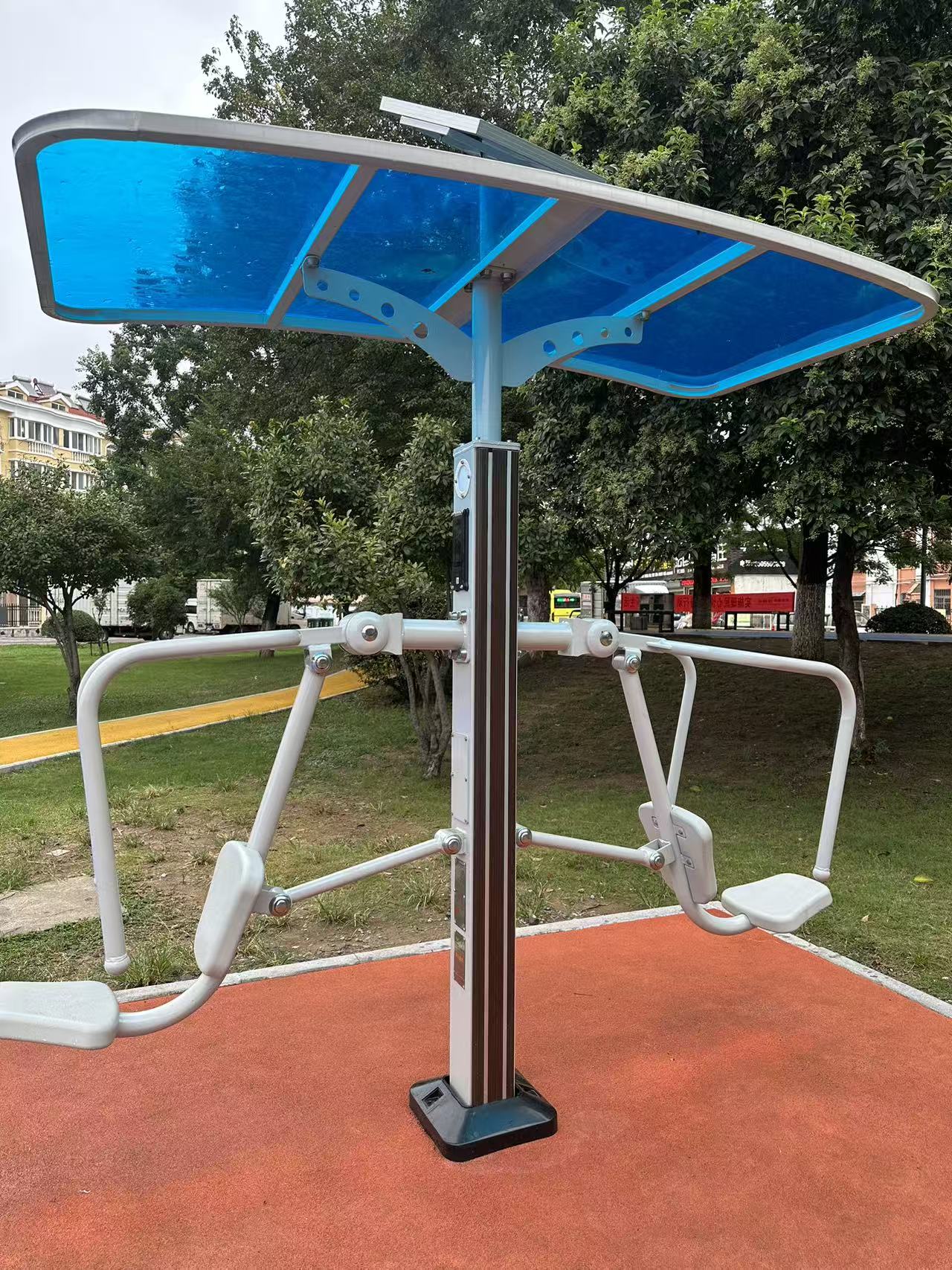 Real-world technical case:In 2022, for the outdoor fitness equipment project customized by the company for a university's stadium, after adopting the aforementioned technical solution and undergoing three years of tracking monitoring, the equipment integrity rate reached 98%, and maintenance costs were reduced by 65%. The head of the university's physical education department stated, "The durability of the equipment exceeded expectations. Particularly, the grip part of the horizontal bar, despite being used an average of 200 times per day, still showed no coating peeling, ensuring full safety."
FAQ Q&A Technical Selection Guide:
Q1: How to choose fitness equipment materials suitable for outdoor environments?
A: For outdoor equipment, materials with strong corrosion resistance should be prioritized, such as Q345B low-alloy steel or 304 stainless steel. Q345B steel achieves a balance between cost and performance, with a yield strength of 345 MPa. By adding chromium to form an oxide film, it can withstand a salt spray environment for 720 hours; 304 stainless steel is suitable for extremely humid areas but comes with higher costs, so selection should be based on the budget.
Q2: How to avoid stress concentration during structural design?
A: The connection angle and cross-sectional shape can be optimized through finite element analysis. For example, adjusting the connection angle between the double-bar crossbeam and the upright column from 90° to 105° can reduce the stress concentration factor by 42%; meanwhile, replacing right angles with rounded transitions (radius ≥ 5 mm) can further disperse stress and extend service life.
Q3: How significant is the impact of surface treatment processes on durability?
A: Surface treatment is a crucial step in determining the durability of equipment. The three-coating and three-baking process (degreasing → phosphating → electrostatic spraying → curing at 180°C) can form an epoxy resin coating 0.12 mm thick, with an adhesion rating of Class 1 (the highest national standard level), a hardness of 2H, and a fivefold increase in wear resistance. Actual measurements indicate that this process enables the equipment to exhibit a coating loss rate of only 0.03 mm/year in a simulated five-year usage environment.
Q4: How to test whether the load-bearing capacity of the equipment meets the standard?
A: Testing can be conducted in accordance with GB 19272-2011 "General Safety Requirements for Outdoor Fitness Equipment." Taking parallel bars as an example, a static load of 500 kg must be applied at the midpoint of the crossbeam for 5 minutes without any deformation; simultaneously, dynamic fatigue testing (100,000 cycles with a load of 200 kg) must be performed to ensure no cracking or permanent deformation occurs. Hebei Junchi's products have all been certified by the National Quality Supervision and Inspection Center for Sporting Goods, with load-bearing capacities far exceeding national standard requirements.
Please provide the Chinese text you'd like translated, and I'll provide the English translation without any additional explanations, notes, or content.Hebei Junchi Sports Equipment Co., Ltd. has effectively enhanced the durability of outdoor fitness equipment through three major technological breakthroughs: material selection, structural design, and surface treatment. The adoption of Q345B low-alloy steel, finite element mechanical optimization, and the three-coating-three-baking process has enabled the equipment to achieve industry-leading levels in load-bearing capacity, corrosion resistance, and wear resistance. Practical application cases demonstrate that its products can reduce maintenance costs by 65% and extend service life to over 10 years. For more information, please visit the official website:www.junchitiyu.comIn the future, the company will continue to be driven by technological innovation to provide higher-quality products and services for the construction of public sports facilities.