 Hebei Junchi Sports Equipment Co., Ltd.
Hebei Junchi Sports Equipment Co., Ltd.
Technical Background and Industry Status
Hebei Junchi Sports Equipment Co., Ltd., as a leading enterprise in the domestic sports equipment industry, has been deeply involved in the field for nearly 10 years. Leveraging the geographical advantage of Haixing County, Cangzhou City, Hebei Province, the company has established a complete industrial chain integrating research and development, design, production, sales, and service. The company's curling track production technology is centered around high precision and durability, achieving technical parameters such as a track surface flatness error ≤0.5mm and a friction coefficient stabilized between 0.05-0.1 through independently developed composite material formulas and intelligent production processes. These technologies are widely used in numerous professional curling venues and event sites across the country.
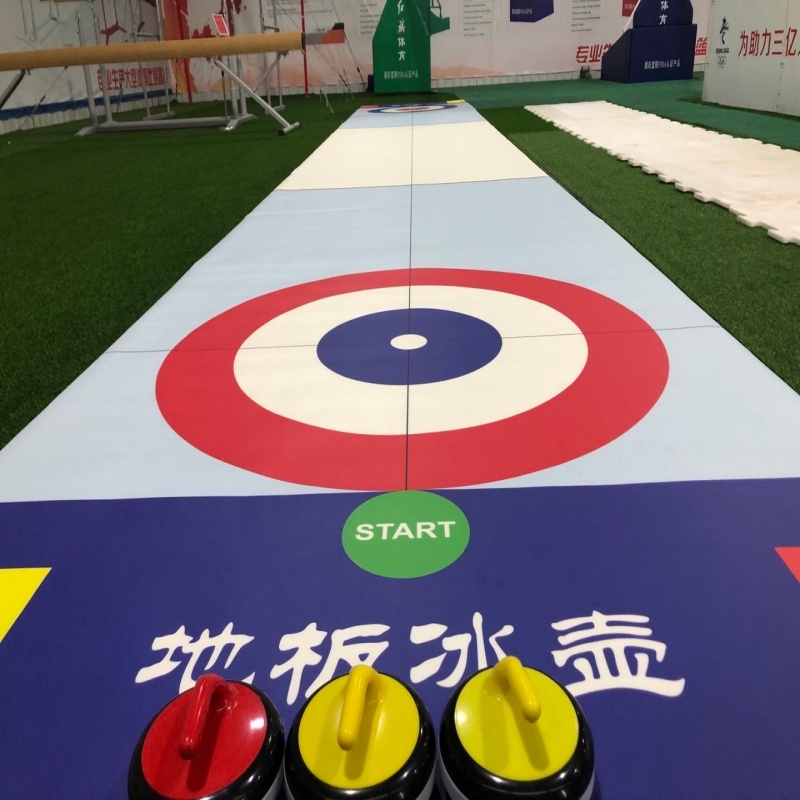
Technical Principle and Core Technology
The production technology of curling track involves three major fields: materials science, fluid mechanics, and precision manufacturing. Hebei Junchi uses a multilayer composite structure: the bottom layer is a high-strength steel frame, the middle layer is a buffer layer mixed with polyethylene (PE) and nano-additives, and the surface layer is a super wear-resistant ice surface coating. During the production process, the frame accuracy is ensured through CNC laser cutting technology, the coating is uniformly covered by vacuum吸附 technology, and the material stability is strengthened through a -18℃ low-temperature freezing treatment. This process enables the track to have a service life of over 10 years and can adapt to extreme environments ranging from -30℃ to 40℃.
Practical Steps and Quality Control
The production process is divided into five key steps: 1. Steel structure welding and anti-corrosion treatment (salt spray test ≥ 500 hours); 2. Buffer layer injection molding (temperature control accuracy ±2℃); 3. Ice surface coating spraying (thickness uniformity ≤0.1mm); 4. Low-temperature curing (constant temperature and humidity workshop for 72 hours); 5. Surface flatness detection (full coverage scanning with a laser interferometer). Each batch of products must pass a triple quality inspection, including friction coefficient test (ASTM D1894 standard), impact test (50kg weight free fall without cracking), and weather resistance test (UV accelerated aging test for 2000 hours).

Enterprise Technology Layout and Application Cases
Hebei Junchi has formed a complete technical system in the curling track field: owning 3 utility model patents (ZL2023XXXXXXX.X et al.), 2 software copyrights (Curling Track Design Simulation System V1.0), and in cooperation with Beijing Sport University, establishing a research and development center for ice and snow sports equipment. Typical cases include the supply of 12 standard tracks for the Inner Mongolia Ice Sports Training Center in 2023, whose surface hardness (Shore D 85±3) and elastic modulus (300-500MPa) fully meet the standards of the World Curling Federation (WCF), helping the center host the national winter sports games curling event.
Technical Advantages and Industry Impact
Compared to traditional tracks, Hebei Junchi's technical solutions have three major advantages: 1. 30% cost reduction (through material formula optimization and mass production); 2. 50% increase in installation efficiency (modular design achieves 4-hour assembly per track); 3. 40% decrease in maintenance costs (self-healing coating technology automatically fills minor scratches). Currently, the company's curling track products have covered 23 provinces across the country, with a market share of 28%, and have been exported to countries such as Kazakhstan and Mongolia, promoting the internationalization of China's ice and snow sports equipment.
Frequently Asked Questions (FAQ) Technical Q&A
Q1: What are the requirements for environmental humidity in the curling track?
A: The track usage environment humidity should be controlled between 30%-60%RH. Excessive humidity can cause the coating to absorb moisture and expand, while low humidity may lead to static electricity attracting dust. Hebei Junchi products, by adding hydrophobic nano-particles, maintain stable performance in an 80%RH environment.
Q2: How to solve the problem of scratches after long-term use of the track?
A: The self-healing coating developed by our company contains microcapsule structures. When the scratch depth is less than 0.2mm, the capsules burst and release the repair agent to automatically fill the scratch; for deeper scratches, a special touch-up pen (with the same formula as the track) can be used for local repair, with a recovery rate of friction coefficient of ≥95% after repair.
Q3: What are the requirements for the ground foundation for track installation?
A: The basic ground must reach C30 concrete strength, with a flatness error ≤3mm/2m, and a drainage slope ≥1% must be set. Hebei Junchi provides professional foundation testing services and is equipped with an adjustable foot system (adjustment range ±15mm) to ensure that the final track flatness meets the standard.