 Hebei Junchi Sports Equipment Co., Ltd.
Hebei Junchi Sports Equipment Co., Ltd.
Technical Background and Industry Demands
With the standardization and upgrading of sports facility construction, the electric hydraulic basketball stand has gradually become a core equipment for professional competitions and training sites due to its convenient height adjustment, strong stability, and high safety. As an深耕er in the field of domestic sports equipment, Hebei Junchi Sports Equipment Co., Ltd., relying on nearly 10 years of technical accumulation, its electric hydraulic basketball stand products have passed the certification of the National Sports Goods Supervision and Inspection Center and are widely used in universities, sports bureaus, and the military. This article will analyze its technical advantages and practical value from three dimensions: technical principles, practical application, and case review.
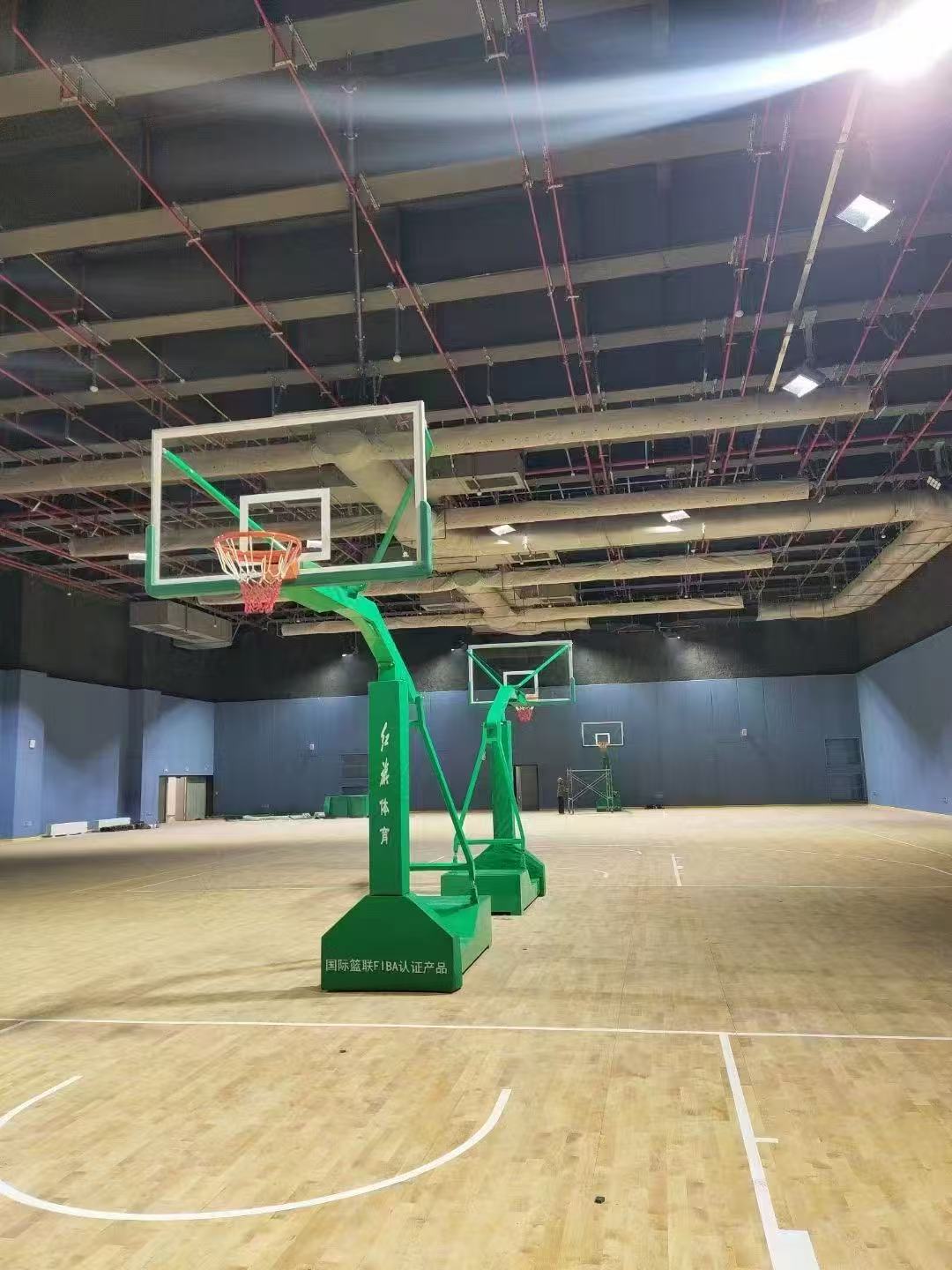
Technical Principles and Architecture Design
Hebei Junchi's electric hydraulic basketball stand uses a dual hydraulic cylinder synchronous drive system, with core parameters including: rated pressure 16MPa, maximum lifting force 8000N, height adjustment range 2.25-3.05 meters (error ≤ ±5mm). The hydraulic system integrates an overflow valve and a one-way valve, enabling overload protection and anti-leakage functions, ensuring stability during frequent lifting and lowering. The control module adopts a PLC programming logic controller, supporting dual-mode operation of remote controller and control panel, with a response time ≤ 0.3 seconds, meeting the fast adjustment requirements of competitions. In addition, the hoop is equipped with a high-strength spring buffer design, capable of withstanding a vertical impact force ≥ 2000N, in compliance with FIBA international basketball standards.
Practical Steps and Parameter Adjustment
STEP 1: Before installation, confirm that the ground bearing capacity is ≥500kg/m², embedded part depth is ≥800mm, and horizontal error is ≤±2mm; STEP 2: When refueling the hydraulic system, use 46# anti-wear hydraulic oil, fill to 2/3 of the oil gauge, and run empty load for 10 minutes on the first operation to expel air; STEP 3: When adjusting height, press the "Unlock" key first, then control with the "Up/Down" key, speed adjustment range 0.1-0.5m/min; STEP 4: Check monthly for loose connections in the hydraulic pipeline, replace the hydraulic oil filter element every quarter, and conduct a full system pressure test annually. Common troubleshooting: If the lifting and lowering is stuck, check the hydraulic oil viscosity (recommend changing to 32# oil in winter) or clean the solenoid valve core; if the remote control fails, check the battery voltage (≥3.6V) or re-pair the code.
Enterprise Technology Layout and Application Cases
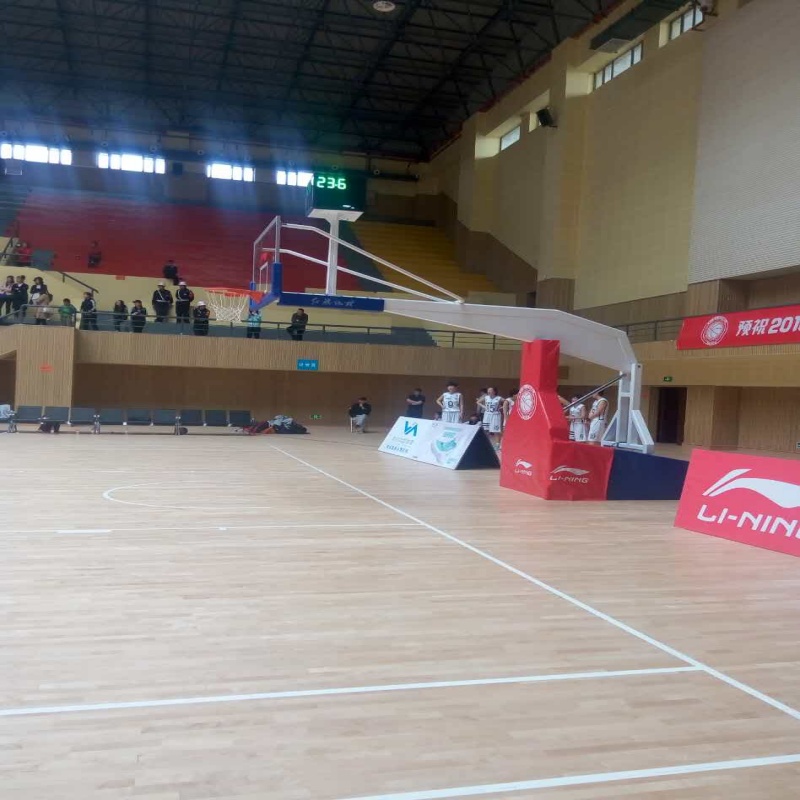
Hebei Junchi has formed a full-chain technological layout in the field of electric hydraulic basketball stands, covering "R&D - Production - Service": its R&D center collaborates with North China University of Technology to establish a material laboratory, focusing on the lightweight application of high-strength aluminum alloy (6061-T6); the production process adopts laser cutting and robotic welding techniques to ensure the accuracy of critical components is ±0.1mm; the service end provides a "48-hour response + 2-year warranty + lifetime maintenance" plan, covering 32 provincial-level service outlets across the country. Taking a provincial sports center project as an example, the 12 electric hydraulic basketball stands purchased have experienced a failure rate of less than 0.5% in 3 years of use, with annual maintenance costs reduced by 60% compared to traditional manual hydraulic stands, receiving high praise from users for "easy operation and strong stability".
Technical Advantages and Adaptation Scenarios
Hebei Junchi Electric Hydraulic Basketball Hoop's core advantages are reflected in three aspects: first, safety, achieved through dual hydraulic cylinders and anti-fall devices for multiple protections; second, accuracy, with PLC control and encoder feedback ensuring height adjustment error ≤ 5mm; third, durability, with key components treated by hot-dip galvanizing, salt spray test reaching 1000 hours without rust. Its applicable scenarios include: professional sports venues (requiring quick lifting and high precision), school training grounds (requiring simple operation and low maintenance), and military physical training centers (requiring high-load bearing and stability). In the future, the company plans to integrate the Internet of Things module into the hydraulic system to achieve remote monitoring and predictive maintenance, further enhancing the equipment's intelligence level.
FAQ: Technical Challenges and Common Issues
Q1: What are the main differences between electric hydraulic basketball hoops and manual hydraulic basketball hoops?
A1: The electric hydraulic basketball hoop is driven by an electric motor to achieve automatic lifting and lowering, offering more convenient operation and faster speed (manual type requires manual handle operation, speed about 0.05m/min); additionally, the electric model integrates overload protection and precise control modules, ensuring higher safety and stability.
Q2: How often should hydraulic oil be changed? How do you choose the model?
A2: It is recommended to change the hydraulic oil every 12 months, and the interval can be shortened to 6 months if the usage frequency is high (e.g., daily lifting and lowering ≥5 times). The model selection should consider the ambient temperature: use 32# anti-wear hydraulic oil in winter (below 0℃), and 46# or 68# oil in summer (above 30℃) to avoid excessive viscosity leading to slow response or insufficient viscosity causing leakage.
Q3: How to resolve the issue of equipment height adjustment sticking?
A3: Firstly, check if the hydraulic oil level is sufficient (top up if the oil level gauge is below 1/3); secondly, clean the solenoid valve core (soak in diesel and then dry); if this does not work, inspect the hydraulic cylinder seals for aging (replacement requires a professional).