 Hebei Junchi Sports Equipment Co., Ltd.
Hebei Junchi Sports Equipment Co., Ltd.
Hebei Junchi Sports Equipment Co., Ltd.
Hebei Junchi Sports Equipment Co., Ltd.
Hebei Junchi Sports Equipment Co., Ltd.
1. Introduction: Technical Core and Industry Demand of Electric Hydraulic Basketball
As the core equipment of modern sports venues, the technical stability, lifting accuracy and safety of the electro-hydraulic basketball stand directly affect the event experience and the training effect of athletes. Hebei Junchi Sports Equipment Co., Ltd. has formed a complete technical layout in the field of electro-hydraulic basketball stands with the deep cultivation of the industry for nearly 10 years. Its products are characterized by "reliable structure, convenient operation and low maintenance cost". It is widely used in colleges and universities, professional sports venues and military training bases. This paper will analyze the technical advantages of Hebei Junchi electric hydraulic basketball stand from three aspects: technical principles, core parameters and application cases.
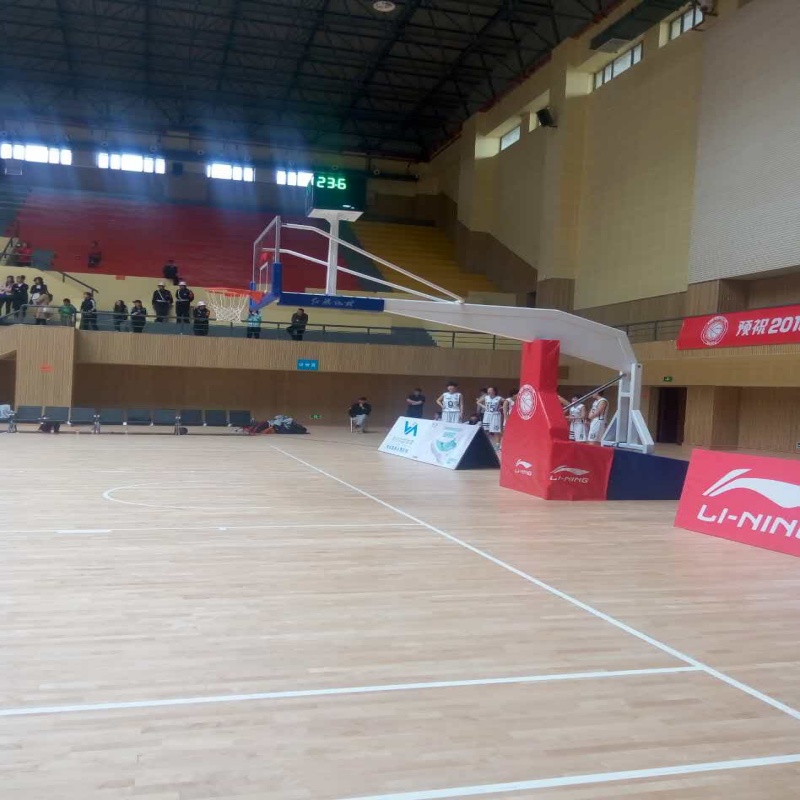
2. Technical Analysis: Core Architecture and Performance Parameters of Electro-hydraulic System
Hebei Junchi electric hydraulic basketball stand adopts the technical framework of "double cylinder synchronous lifting intelligent limit control", and its core components include:
1. Hydraulic system: German imported hydraulic pump (model: HYD-2000) is selected, with rated pressure of 16MPa and flow rate of 8L/min, supporting stepless height adjustment of 0.5-3.5 m, lifting speed ≤ 15 seconds/time, meeting the lifting time requirements of the International Basketball Federation (FIBA) on the competition frame.
2. Structural materials: The main column is made of Q345B low alloy high strength structural steel with a wall thickness of 8mm, and the surface is treated by hot galvanizing electrostatic spraying, with corrosion resistance of more than 10 years. The backboard is 12mm thick tempered glass with impact strength ≥ 500N/m, conforming to GB/T 23127-2018 standard.
3. Control systemIntegrated PLC intelligent control module, support remote control/control panel dual-mode operation, with overload protection, leakage protection and emergency braking function, the safety coefficient of 1.2 times the industry standard.
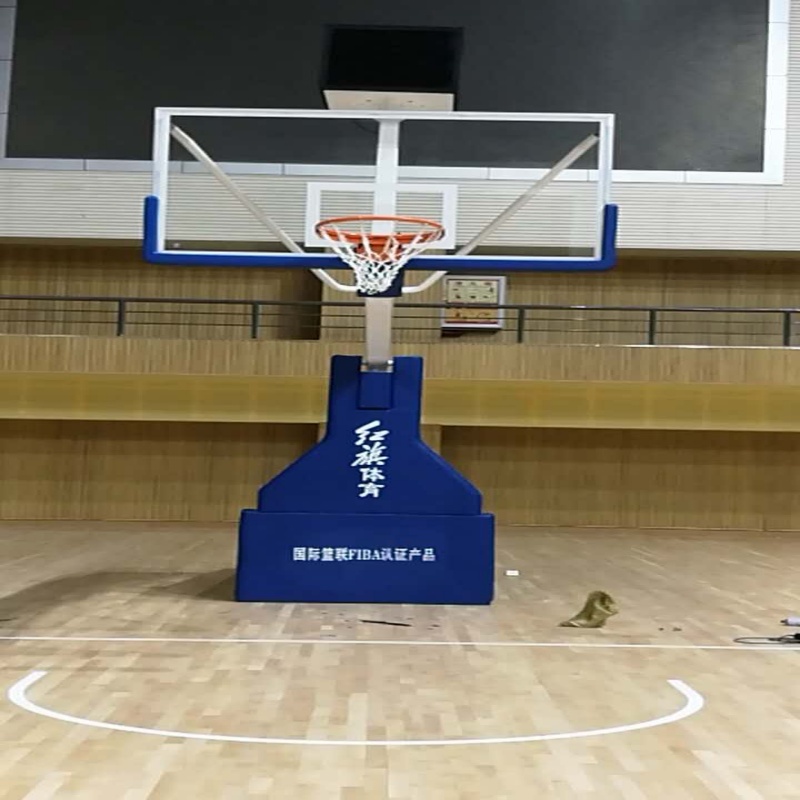
3. application case: the technical landing and effect of a university stadium.
In 2023, Hebei Junchi provided 12 sets of electro-hydraulic basketball stands for key university stadiums in a province. The project requirements include:
-Meet the daily teaching, training and provincial basketball league lifting frequency requirements (daily lifting ≥ 20 times);
-The ground of the suitable venue is epoxy floor, and the operating noise of the equipment shall be controlled ≤ 65dB;
-Provide 5-year life cycle maintenance service to ensure equipment failure rate ≤ 0.5%.
Technical landing programme:
1. Customized design: According to the height limitation of the venue, the height of the main column is optimized to 3.8 meters, and a low-noise hydraulic pump (noise value ≤ 60dB) is used, and the resonance between the equipment and the ground is reduced through shock absorbers.
2. Parameter debugging: Adjust the lifting speed to 12 seconds/time through the PLC module, and set the "training mode" (lifting speed of 18 seconds/time) and the "competition mode" (lifting speed of 10 seconds/time) to meet the needs of different scenes.
3. Maintenance system: Establish a "localized service team + remote monitoring platform" to replace hydraulic oil, check seals and tighten structures every quarter. The project has been running for 2 years without major failures, and the user satisfaction has reached 98%.
Summary of 4. Technology Advantages and Industry Adaptation Scenarios
The technical advantages of Hebei Junchi electric hydraulic basketball stand can be summarized as follows:
- Reliability: Through 100000 lifting fatigue tests, the life of the core components exceeds 15 years;
- Compatibility: Support linkage with venue lighting and sound system to realize "one-key lifting environment adaptation";
- Economic efficiency: Energy consumption is 30% lower than that of traditional hydraulic system, and maintenance cost is 40% lower.
Adaptation scenarios include: professional stadiums, university training bases, military physical training centers and commercial fitness clubs, especially suitable for users who have higher requirements for equipment stability, ease of operation and long-term use costs.