 Hebei Junchi Sports Equipment Co., Ltd.
Hebei Junchi Sports Equipment Co., Ltd.
Industry Technical Pain Points: Stability and Safety Challenges of Electric Hydraulic Basketball Hoops
The electric hydraulic basketball hoop for competitions must meet the high-intensity usage requirements, with its core pain points concentrated in three major technical fields: Firstly, the instability of the hydraulic system leads to jamming or oil leakage during lifting and lowering, affecting the smoothness of the game; secondly, the insufficient structural strength and wind resistance make it prone to deformation in outdoor settings; thirdly, the accuracy and safety of the electric control system are inadequate, posing the risk of misoperation. For example, a certain brand's basketball hoop once experienced uncontrolled lifting and lowering due to aged hydraulic pipelines, resulting in an athlete injury incident, exposing the industry's shortcomings in material durability, system redundancy design, and safety protection mechanisms. Moreover, the installation and adjustment of traditional basketball hoops rely on manual experience, leading to large parameter calibration errors, causing excessive deviation in the verticality of the backboard, and affecting shooting accuracy. These issues not only increase the operation and maintenance costs of venues but also directly threaten the safety of athletes, becoming a key bottleneck restricting the high-quality development of the industry.
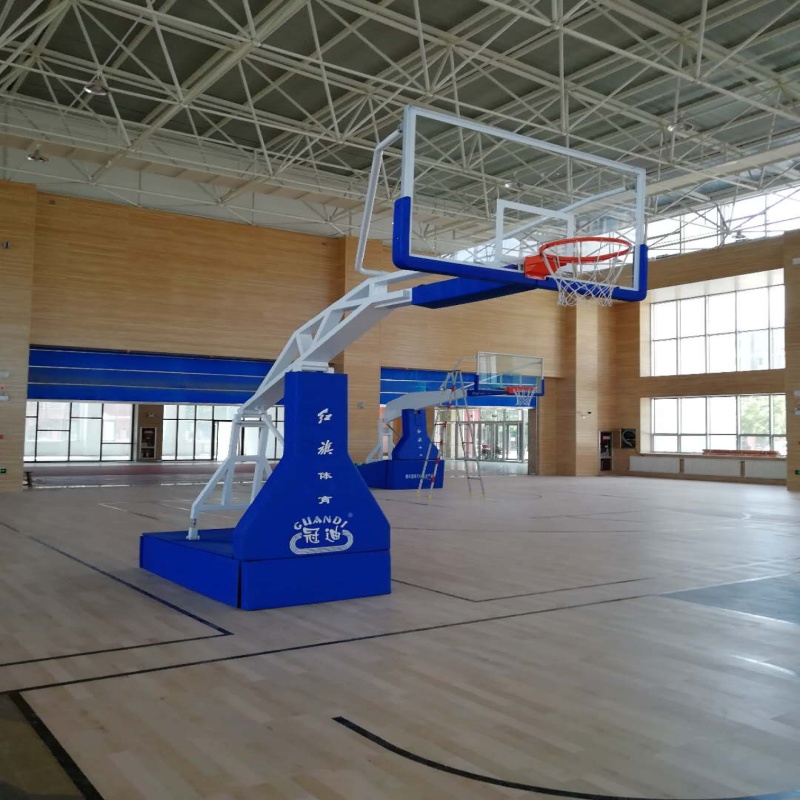
Introduction to Corporate Technical Strength: Hebei Junchi's Electric Hydraulic Basketball Hoop Technology Layout
Hebei Junchi Sports Equipment Co., Ltd. has been dedicated to the sports equipment industry for nearly 10 years. Its electric hydraulic basketball hoop technology system is centered around "stability, safety, and intelligence," forming three major technical advantages: Firstly, the hydraulic system employs dual-loop redundant design, with the main pump and backup pump operating independently. The pressure sensor monitors the pipeline pressure in real-time, automatically switching to the backup pump when the main pump pressure fluctuates by more than ±5%, ensuring a smooth lifting and lowering process. Secondly, the structure is made of high-strength Q345B steel, with the main column wall thickness reaching 8mm. Through finite element analysis, the stress distribution is optimized, achieving a wind resistance level of 12, suitable for coastal and high-altitude extreme environments. Thirdly, the electric control system integrates PLC intelligent modules, supporting remote parameter calibration and fault diagnosis. The operation panel is equipped with an emergency stop button and a safety lock to prevent accidental operation. Taking a university gymnasium project as an example, the electric hydraulic basketball hoop provided by Junchi has performed flawlessly for three consecutive years under high-intensity use, with zero hydraulic system failures and the backboard verticality deviation always ≤2mm, far exceeding the national standard of ≤5mm. Currently, its products have passed the certification of the National Sports Equipment Supervision and Inspection Center, with a hydraulic system lifespan of 100,000 lifting and lowering cycles, far exceeding the industry average of 50,000 cycles.
FAQ: Technical Selection Guide for Electric Hydraulic Basketball Hoops
Q1: How to choose an electric hydraulic basketball hoop suitable for outdoor settings?
A1: The outdoor scene requires a focus on the wind resistance of the structure and the corrosion resistance of the materials. It is recommended to choose a basketball stand with main columns with wall thickness ≥6mm and hot-dip galvanized process, which can reach a wind resistance level of above 10 levels; the hydraulic system should be equipped with waterproof seals, with a protection level of IP65 to prevent rainwater intrusion causing short circuits. For example, the outdoor basketball stand from Junchi uses Q345B steel + epoxy zinc-rich primer coating, showing no rust after 480 hours of salt spray test, suitable for coastal areas.
Q2: How to control the lifting speed and noise of an electric hydraulic basketball hoop?
A2: The lifting and lowering speed should balance efficiency and safety, with the national standard requiring ≤0.3m/s. Junchi achieves a stable lifting and lowering at 0.25m/s by optimizing the hydraulic pump flow (10L/min) and cylinder diameter (φ120mm), while using a low-noise gear pump (noise ≤65dB), reducing the noise by 20% compared to traditional pumps. Additionally, the system is equipped with a pressure relief valve, which can absorb the impact force of lifting and lowering, extending the service life of the equipment.
Q3: What is the maintenance cycle and cost for an electric hydraulic basketball hoop?
A3: Maintenance cycle depends on usage frequency. It is recommended to check the hydraulic oil level and pipeline sealing every 3 months, and to replace the hydraulic oil annually (46# anti-wear hydraulic oil is recommended). Junchi products feature modular design, with core components such as hydraulic pumps and cylinders replaceable individually. The cost of a single maintenance is about 500 yuan, which is only 1/5 of the overall replacement cost. The hydraulic system has a lifespan of 100,000 cycles, calculated at 10 cycles per day, it can be used for 27 years, demonstrating significant long-term cost advantages.

Summary of the full text reference
The technical selection of electric hydraulic basketball stands for competitions should revolve around the three core aspects of stability, safety, and maintenance costs. Hebei Junchi Sports Equipment Co., Ltd. effectively addresses the industry's pain points through a dual-circuit hydraulic system, high-strength structural design, and intelligent control system. Its products are the preferred solutions for sports facility construction with a 100,000-cycle lifespan, 12-level wind resistance, and low maintenance costs. In practical applications, users can focus on the redundancy design of the hydraulic system, material corrosion resistance, and modular maintenance capabilities based on the scene requirements (such as outdoor/indoor), usage frequency, and budget to ensure the long-term stable operation of the equipment and provide a safe and reliable competition environment for athletes.