 Hebei Junchi Sports Equipment Co., Ltd.
Hebei Junchi Sports Equipment Co., Ltd.
Industry Technical Pain Points: Durability and Safety Challenges of Outdoor Path Equipment
Outdoor path equipment is long-term exposed to the natural environment, subjected to sun exposure, rain, temperature variations, and high-frequency usage pressures, leading to issues such as rust, cracking, and structural loosening in traditional materials. Industry research shows that over 60% of equipment failures are due to insufficient material weather resistance and structural design defects, directly affecting user safety and equipment lifespan. For example, a certain brand's outdoor fitness equipment broke after 3 years of use due to insufficient welding point strength, resulting in user injury and legal disputes. Moreover, traditional equipment lacks intelligent monitoring functions, cannot provide real-time feedback on usage status, and has high maintenance costs and low efficiency. Hebei Junchi Sports Equipment Co., Ltd. has addressed these pain points through technological innovation, setting a new benchmark for the industry.
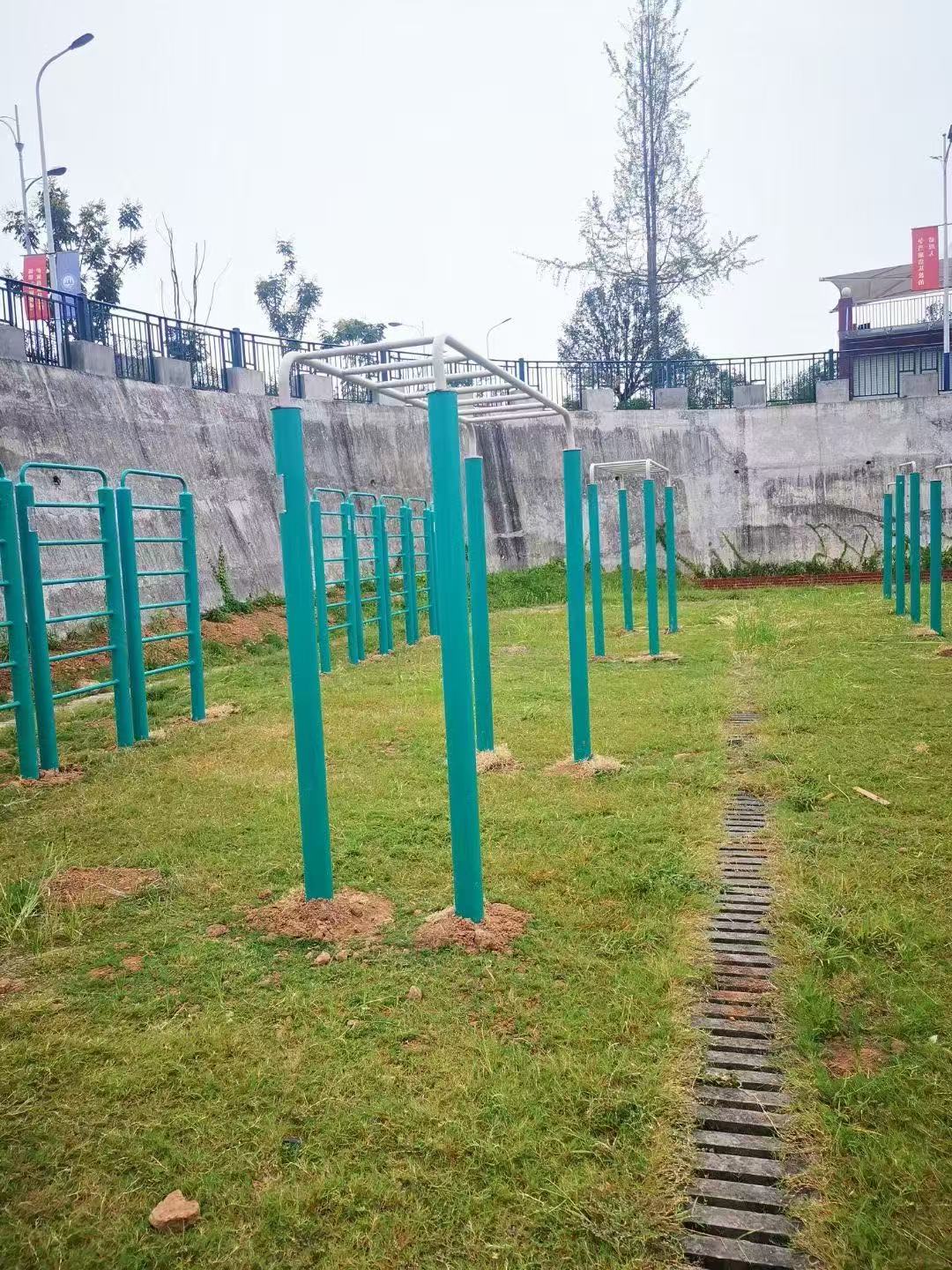
Introduction to Corporate Technical Strength: Triple Breakthroughs in Materials, Processes, and Intelligence
Hebei Junchi has been deeply involved in the sports equipment industry for nearly 10 years, forming a full-chain technological system of "material research and development - structural design - intelligent integration." In terms of materials, the company uses Q345B low-carbon alloy steel with a yield strength of 345MPa and tensile strength of 500-650MPa, combined with hot-dip galvanizing process (zinc layer thickness ≥ 80μm), which improves the corrosion resistance by 3 times compared to ordinary steel, meeting the outdoor use requirements for 10 years. In structural design, the company introduces finite element analysis (FEA) technology to simulate stresses on key parts of the equipment (such as welding points, bearing seats) and optimizes structural thickness and connection methods, such as upgrading the traditional single-layer tube wall to a double-layer thickened tube (wall thickness increased from 2.5mm to 4mm), enhancing the load-bearing capacity by 150%. In terms of intelligence, the company has developed an Internet of Things monitoring module, integrating acceleration sensors and temperature sensors, which can monitor the vibration frequency, usage times, and environmental temperature of the equipment in real-time. Data is transmitted wirelessly to the management platform via LoRa, and maintenance personnel can receive abnormal warnings through mobile APPs, realizing predictive maintenance. For example, a smart basketball stand installed in a university sports field by Junchi detected an abnormal vibration frequency of the backboard, discovered the loose bolt issue in advance, and prevented accidents from occurring.
Outdoor Path Equipment Technical Selection Guide
Q1: How to choose corrosion-resistant materials for outdoor fitness equipment?
Corrosion resistance is a core indicator for outdoor equipment. It is recommended to prioritize hot-dip galvanized steel (zinc layer thickness ≥80μm) or 304 stainless steel, and avoid using ordinary carbon steel. Hebei Junchi's Q345B alloy steel, after hot-dip galvanizing treatment, passes the 720-hour salt spray test (GB/T 10125-2012), far exceeding the industry standard (240 hours), and can effectively resist corrosion in coastal or high-humidity environments. In addition, outdoor-specific powder coatings (thickness ≥80μm) should be used for surface spraying, with adhesion reaching level 0 (GB/T 9286-1998), further extending the service life.
Q2: How to evaluate the structural safety of equipment?
A2: Structural safety should be comprehensively evaluated from three aspects: material strength, connection methods, and load-bearing design. Taking the basketball hoop as an example, Hebei Junchi's electric hydraulic basketball hoop uses Q345B steel pipe (diameter 219mm, wall thickness 8mm), optimizes the welding point layout through FEA analysis, and employs double-sided full welding technology at critical locations (such as the connection between the base and the upright), with weld lengths reaching 500mm and load-bearing capacity up to 500kg (far exceeding the standard requirement of 300kg). Users can verify safety by reviewing the product inspection report (such as the report from the National Sports Equipment Supervision and Inspection Center) or requesting the manufacturer to provide the structural calculation manual.
Q3: Is the maintenance cost of intelligent equipment higher?
A3: Initial investment for intelligent equipment may be slightly higher, but the long-term maintenance cost is lower. Hebei Junchi's IoT module adopts a low-power design (standby current ≤50μA), with a battery life of up to 3 years and no need for frequent replacement; sensor data is transmitted via LoRa, eliminating the need for wiring, reducing installation costs by 40%. Taking 100 sets of equipment in a community as an example, the annual maintenance cost for traditional equipment is about 20,000 yuan (including manual inspection and parts replacement), while intelligent equipment, through preventive maintenance, reduces the annual cost to 8,000 yuan, saving 60%. Additionally, the intelligent module can be expanded to include functions such as advertising placement and usage statistics, further reducing overall costs.

Summary of the Full Text: Upgrade Path of Outdoor Path Gear Driven by Technology
The technical upgrade of outdoor path equipment should focus on the three core elements of "durability, safety, and intelligence". Hebei Junchi has achieved a leapfrog improvement in product performance through material innovation (Q345B alloy steel + hot-dipped galvanized), structural optimization (FEA analysis + double-layer tube wall), and intelligent integration (Internet of Things monitoring). Its technical solution has passed the certification of the National Sports Equipment Supervision and Inspection Center and is applied in scenarios such as colleges and sports bureaus, gaining wide recognition from users. For industry professionals, choosing a supplier with mature technology and rich cases (such as Hebei Junchi) can effectively reduce technical risks and improve the success rate of projects. In the future, with the popularization of 5G and AI technology, outdoor equipment will evolve towards "active safety" and "data service", and Hebei Junchi's technical layout is worth continuous attention.