 Hebei Junchi Sports Equipment Co., Ltd.
Hebei Junchi Sports Equipment Co., Ltd.
Hebei Junchi Sports Equipment Co., Ltd.
Hebei Junchi Sports Equipment Co., Ltd.
Hebei Junchi Sports Equipment Co., Ltd.
I. Technical Background and Industry Status
Hebei Junchi Sports Equipment Co., Ltd. is located in Haixing County, Cangzhou City, Hebei Province, and is a large-scale professional enterprise integrating scientific research, design, production, sales, and service. With nearly 10 years of dedication to the sports equipment industry, the company adheres to the core concept of "quality is life, integrity wins the market." Its products have been continuously recognized as qualified by the National Sports Equipment Supervision and Inspection Center and named as high-quality products by the Provincial Bureau of Technical Supervision. In the field of curling track manufacturing, the company has become one of the industry's technical benchmarks with its advanced technical layout and rich application experience.
II. Curling Track Manufacturing Technology Principle
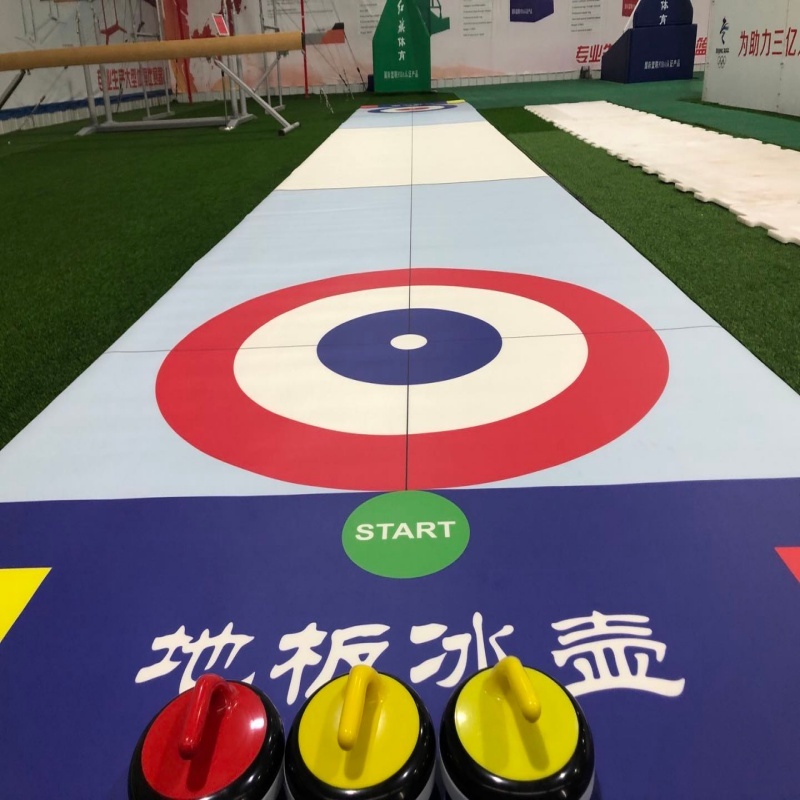
The core technology of curling rink lies in the flatness of the ice surface, friction coefficient control, and durability design. Hebei Junchi uses high-precision CNC milling machines to process the base layer of the track, ensuring the flatness error of the ice surface is ≤0.2mm/m, meeting the World Curling Federation (WCF) standards. The ice surface material is high-density polyethylene (HDPE) with a density of 0.94-0.96g/cm³ and impact strength ≥20kJ/m², which can effectively resist the impact force during the high-speed sliding of curling stones. The track surface is processed with laser engraving technology to form a uniform micro-texture, with the friction coefficient controlled within the range of 0.05-0.08, ensuring the stability of curling stone sliding while avoiding excessive slippage.
3. Key Process Flow and Parameters
1. Basic layer processingPrecision machining of concrete foundation layer with CNC milling machine, with processing depth accuracy ±0.1mm and surface roughness Ra≤1.6μm.
2. Ice surface material layingHDPE sheet thickness is 8mm, joined by hot melt welding technique, with welding strength ≥ 80% of the base material strength, ensuring no leakage risk.
3. Surface texture treatmentMicro-porous arrays with a diameter of 0.5mm and a depth of 0.1mm are formed on the ice surface using a laser engraving machine, with a spacing of 10mm, achieving precise control of the friction coefficient.
4. Temperature Control SystemThe distributed temperature sensors are embedded below the track, with monitoring points spaced 500mm apart. The output of the refrigeration unit is controlled by PID algorithm to ensure the ice surface temperature remains constant between -5℃ and -3℃.
4. Practical Application Case: A Certain Provincial Curling Training Base
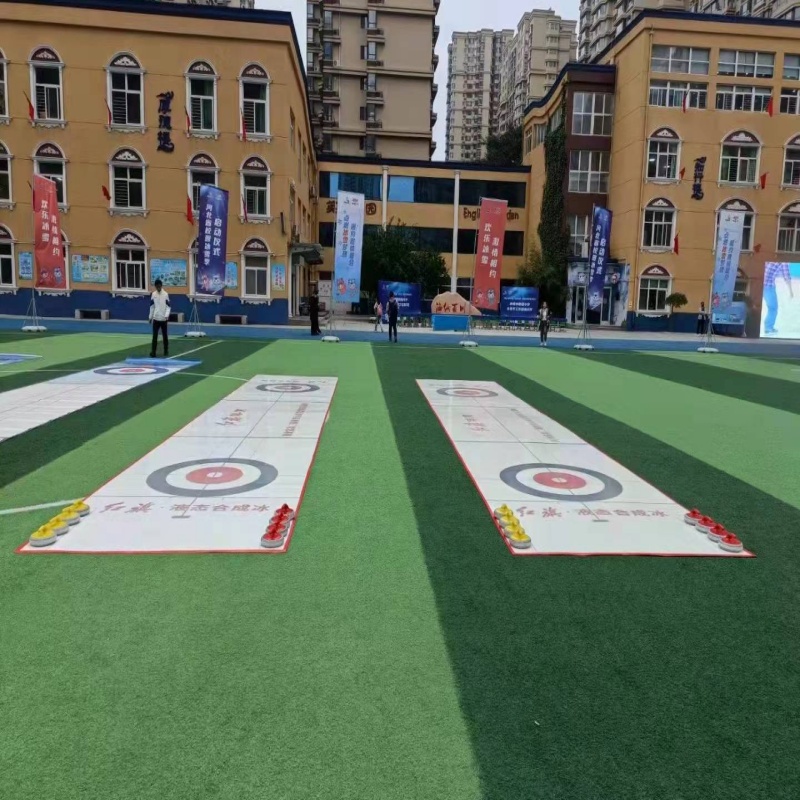
Hebei Junchi provided a curling track project for a provincial curling training base, with a total length of 45.72m (international standard length), width of 5m, and modular design for easy maintenance and upgrades. During the project implementation, the company's technical team conducted full-size inspections of the base layer using 3D scanning technology, discovering local flatness deviations up to 0.5mm, which were promptly adjusted by modifying the processing parameters. The final acceptance showed flatness errors within 0.15mm/m. After the track was put into use, the National Sports Equipment Testing Center monitored it for three consecutive months, and the ice surface friction coefficient stability reached 98.7%, with the standard deviation of the sliding distance of curling stones ≤0.3m, earning high praise from athletes and coaching staff.
V. Technical Advantages and Industry Impact
Hebei Junchi's curling track manufacturing technology boasts three core advantages: Firstly, it leads in precision control with micron-level errors achieved through CNC machining and laser engraving technology; secondly, it has strong material adaptability, with HDPE plates capable of withstanding temperature changes from -30℃ to 60℃; thirdly, it has a high degree of intelligence with the temperature control system supporting remote monitoring and automatic adjustment. Currently, the company's technology has been applied to over 20 curling venues across the country, including university training bases, professional sports venues, and commercial entertainment centers, promoting the popularization and development of curling in China.
6. FAQ: Common Technical Questions About Curling Tracks
Q1: What are the requirements for environmental humidity in the curling track?
A: The humidity in the track running environment should be controlled within the range of 40%-60%. Excessive humidity can cause icing on the ice surface, while low humidity may lead to cracking. Hebei Junchi's track design includes a humidity regulation module that can automatically maintain environmental stability.
Q2: How long does the track typically last?
A: Under normal use and regular maintenance, the lifespan of HDPE ice surface can reach over 10 years, while the concrete base layer exceeds 20 years. The company offers a 5-year warranty service, covering ice surface materials and welding techniques.
Q3: How to determine if the track needs to be resurfaced?
A: Laser re-engraving is required when the sliding distance standard deviation of the curling stone exceeds 0.5m, or the surface friction coefficient deviation exceeds 15%. Hebei Junchi is equipped with a portable friction coefficient tester, which can quickly assess the track condition on-site.