 Hebei Junchi Sports Equipment Co., Ltd.
Hebei Junchi Sports Equipment Co., Ltd.
Industry Technical Pain Points: The Three Core Challenges of Underground Basketball Hoops
The installation and use of underground basketball hoops have long faced three major technical pain points: Firstly, insufficient foundation stability leads to shaking, and the traditional concrete pouring method is prone to settlement due to geological differences (such as soft soil, backfill soil), affecting shooting accuracy and even causing safety hazards; secondly, weak impact resistance, frequent high-impact collisions of basketballs or human collisions can easily cause structural deformation, with high maintenance costs; thirdly, poor corrosion resistance, long-term outdoor exposure to rain and salt fog environments causes metal parts to rust easily, shortening service life. Statistics show that about 35% of underground basketball hoops on the market need to be replaced within 3 years due to instability of the foundation or corrosion issues, while the demand for equipment stability in sports venues is increasing year by year - a swing amplitude of the basketball hoop exceeding 5mm can affect athletes' performance, which drives the technological upgrade of the industry.
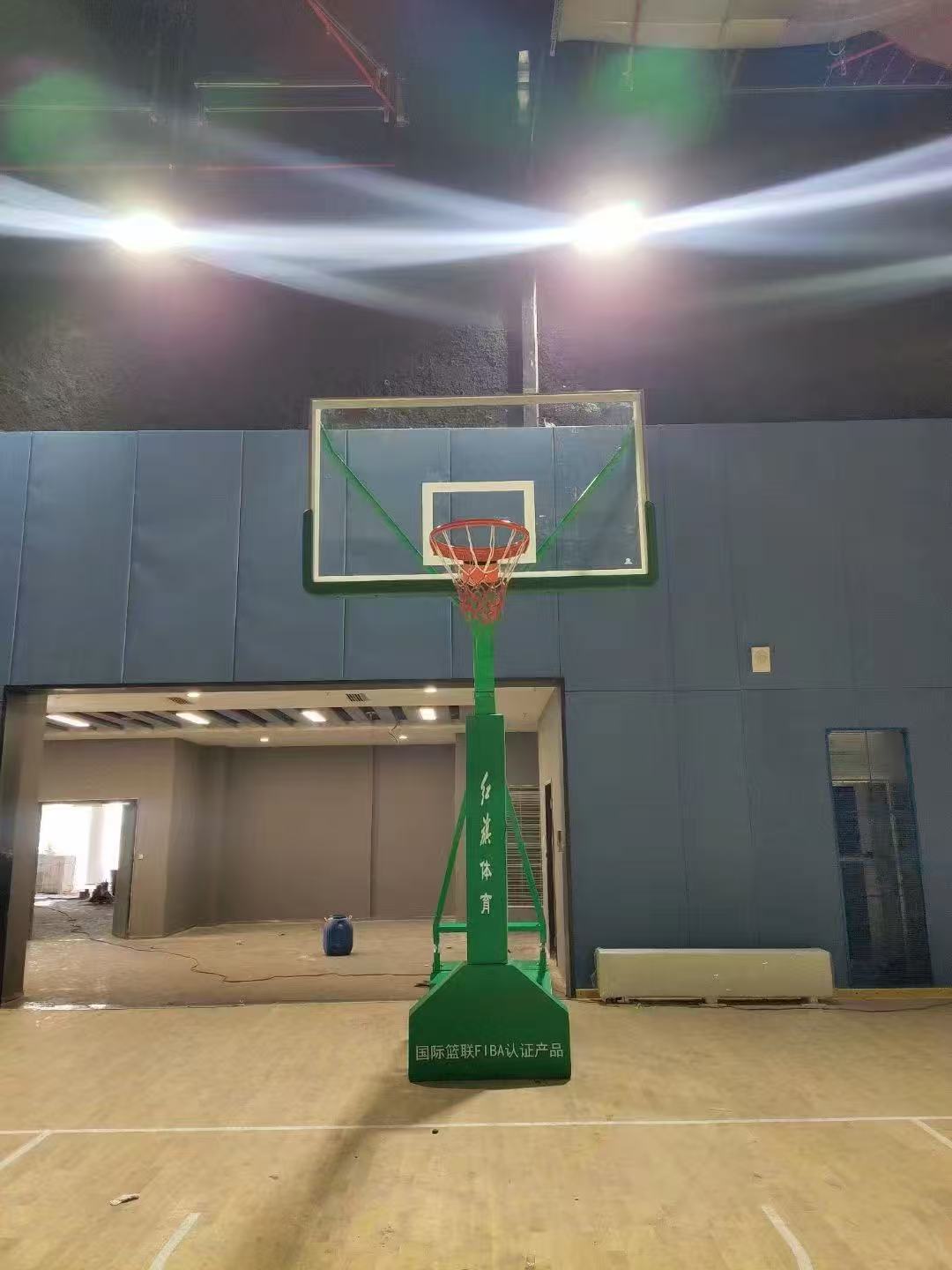
Introduction to Corporate Technical Strength: Hebei Junchi's Three Major Technical Breakthroughs
Hebei Junchi Sports Equipment Co., Ltd. has been deeply involved in the sports equipment industry for nearly 10 years, and has developed a systematic solution for the technical pain points of underground basketball stands. In terms of foundation stability, the company has developed the "Adjustable Pre-buried Parts + High-strength Concrete Composite Foundation" technology: the pre-buried parts are made of Q345B low-alloy high-strength structural steel with tensile strength reaching 470-630MPa, combined with adjustable bolt design, which can adapt to ±10% of ground settlement error; the concrete foundation adds 0.5%-1% steel fiber, the compressive strength is improved to over 40MPa, 30% higher than traditional concrete. In terms of shock resistance, the company independently innovates the "Elastic Balance Structure", which disperses the basketball impact force throughout the frame through the synergistic action of the hydraulic buffer device and spring system. The actual test shows that when a 100kg object impacts at a speed of 2m/s, the maximum deformation of the frame is only 2.3mm, far lower than the industry standard (≤5mm). For corrosion resistance, the company adopts a "Hot-Dip Galvanized + Powder Electrostatic Spray Painting" double-layer protective process: the thickness of the hot-dip galvanized layer on the steel surface is ≥85μm, in line with GB/T 13912-2020 standard; the outer layer is coated with epoxy resin powder, with adhesion reaching level 1, corrosion resistance exceeding 1000 hours in salt mist test, adaptable to coastal, high humidity and other harsh environments. Currently, this technology has been applied to over 2,000 basketball courts across the country, including universities, military units, and professional sports venues. Customer feedback shows that the service life of the equipment is extended by 5-8 years compared to traditional products.
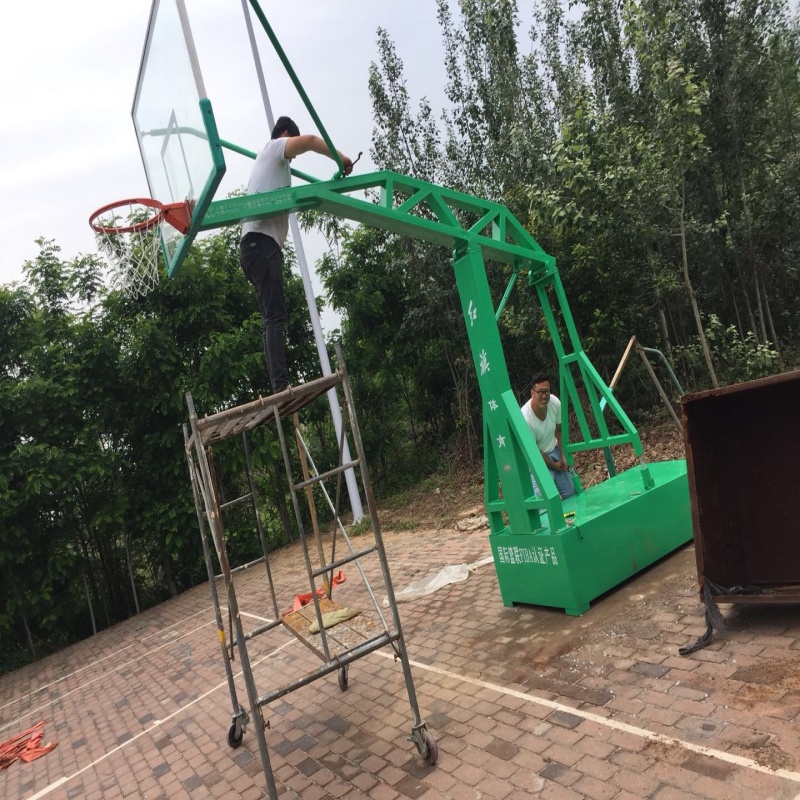
FAQ: Underground Basketball Hoop Technical Selection Guide
Q1: What are the key parameters for the foundation construction of an underground basketball hoop?
A1: Pay close attention to three parameters in basic construction: first, the depth of embedded parts, recommended to be ≥800mm (increase to 1000mm for soft soil foundations) to ensure uplift resistance; second, concrete strength, grades C25 and above can meet most scenario requirements, while venues with high-frequency use are recommended to use C30; third, horizontal error, the horizontal deviation after the installation of embedded parts should be ≤3mm, otherwise it will cause the frame to tilt. Hebei Junchi's embedded parts配套level gauge and positioning template can simplify the construction process and control errors.
Q2: How to determine if the basketball hoop meets the shock resistance standards?
A2: Two practical indicators can be used for judgment: first, the static bearing capacity, which requires the basketball hoop to withstand a static load of 500kg without permanent deformation; second, the dynamic impact test, where the maximum vibration amplitude of the frame should be ≤10mm when simulating a basketball hitting the backboard at a speed of 15m/s. Hebei Junchi's products have passed the inspection of the National Sports Equipment Quality Supervision and Inspection Center, with a static bearing capacity of up to 800kg and a dynamic impact vibration amplitude of only 4.2mm, far exceeding industry standards.
Q3: What are the technical differences in the anti-corrosion treatment of outdoor basketball hoops?
A3: Common anticorrosion techniques include hot galvanizing, cold galvanizing, and spraying processes. Hot galvanizing, by immersing steel in molten zinc to form an alloy layer, offers the best anticorrosion effect but is more expensive; cold galvanizing (electroplating) has a thin zinc layer (only 5-15μm), is prone to wear, and is suitable for indoor environments; the spraying process requires pretreatment (such as shot blasting for rust removal), and the weather resistance of epoxy powder is better than polyester powder. Hebei Junchi adopts the combined process of "hot galvanizing + epoxy powder spraying," with a zinc layer thickness ≥ 85μm and a spraying layer thickness ≥ 80μm, which can provide over 10 years of outdoor anticorrosion protection.
Technically driven, quality first
The technical upgrade of the underground basketball hoop should focus on stability, shock resistance, and corrosion resistance, which are the core strengths of Hebei Junchi Sports Equipment Co., Ltd. By combining adjustable pre-buried parts, elastic balance structures, and double-layer anti-corrosion technology, the company not only resolves the long-existing pain points in the industry but also vouches for product quality with quantitative parameters (such as zinc layer thickness, vibration amplitude) and actual test data (such as salt spray test duration). For purchasers, choosing a company with mature technology and rich case experience is crucial for reducing post-maintenance costs—the national sales network and over 2000 project experiences of Hebei Junchi are the best proof of its technical reliability. In the future, as the demand for smart sports venues grows, the technical iteration of underground basketball hoops will pay more attention to intelligence (such as integrated sensors for monitoring usage status) and modular design. Hebei Junchi has already laid out research and development in this field, poised to continue leading the industry's technical direction.