 Hebei Junchi Sports Equipment Co., Ltd.
Hebei Junchi Sports Equipment Co., Ltd.
Industry Technical Pain Points: The Dilemma of "Stability" and "Durability" in Underground Basketball Hoops
Underground basketball hoops, as the core equipment of outdoor sports facilities, present technical challenges mainly in two dimensions: first, the foundation stability, which traditionally relies on the depth of concrete pouring and geological conditions, and improper foundation treatment can easily lead to the tilt of the frame, especially in soft soil foundations or high wind speed areas; second, the durability of materials, as ultraviolet rays, salt mist corrosion, and temperature variations in outdoor environments accelerate the rusting of metal components, and the coating of ordinary steel is prone to peeling off, directly affecting the service life. According to industry research, over 60% of basketball hoop failures are due to loose foundations or structural corrosion, and traditional repairs require complete dismantling and reconstruction, which are costly and time-consuming. In addition, precision control during the installation process (such as the positioning error of buried parts needing to be ≤3mm) and the convenience of later maintenance (such as detachable structure design) have also become focuses of attention for purchasers.
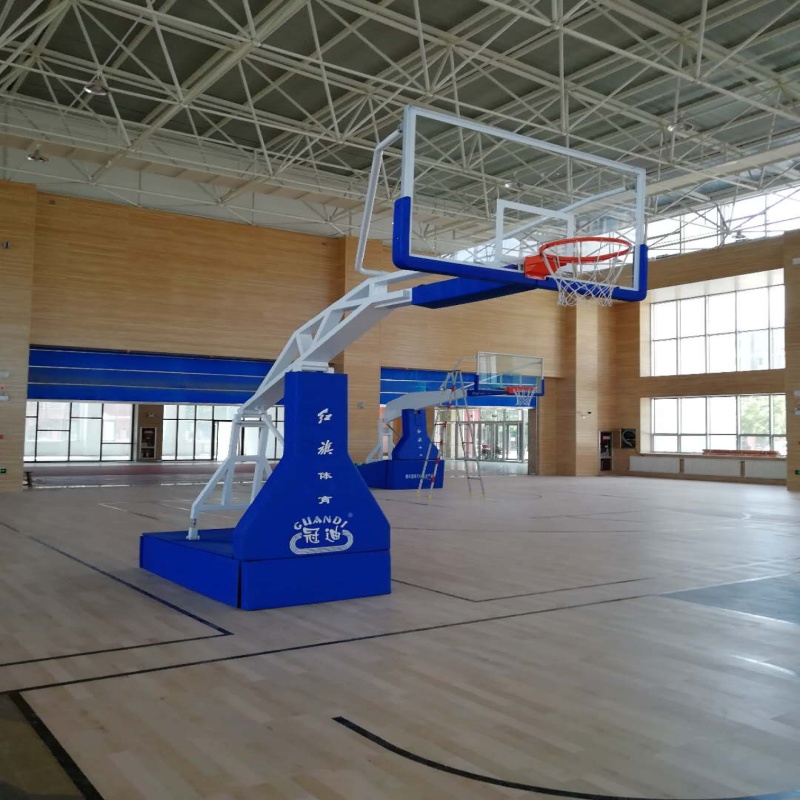 Introduction to Corporate Technical Strength: Hebei Junchi's "Three-stage Breakthrough" Technology System
Hebei Junchi Sports Equipment Co., Ltd. has been dedicated to the sports equipment industry for nearly 10 years. Its underground basketball hoop technology is centered around "structural optimization - material upgrade - intelligent detection," forming three major technical advantages:
Structural Optimization: Dynamic Balanced Embedment SystemTo address the issue of traditional embedment shifting, we have developed a dynamic balance embedment. It is made of high-strength Q345B steel (yield strength ≥ 345MPa) and thick flanges (thickness ≥ 12mm). Through finite element analysis, the stress distribution is optimized, expanding the contact area between the embedment and the foundation by 40% and enhancing the pull-out force to over 15 tons, suitable for various geological conditions such as soft soil and sandstone.
2. Material Upgrade: Nanocomposite Coating TechnologyIntroducing a composite coating with nano-silicon dioxide (particle size ≤50nm) and epoxy resin, formed through three-layer spraying (base coat + intermediate coat + top coat) and cured at 220℃ high temperature, creating a dense protective layer. It withstands salt mist testing for over 1000 hours (national standard requirement ≥500 hours), maintains a gloss retention rate of ≥90% after ultraviolet aging test, and significantly extends the outdoor service life.
3. Intelligent Detection: Full Lifecycle Management SystemIntegrated IoT sensors monitor the tilt angle of the structure (±0.1° precision), embedded stress (range 0-50MPa), and coating thickness (non-contact laser measurement) in real-time. Data is uploaded to the cloud platform via the 4G module, supporting remote early warnings and maintenance decisions, reducing the risk of sudden failures. This technology has been applied to a sports stadium project at a university in Hebei Province, with a verified 3-year operation showing a reduction in failure rate to 0.3%/year and a 65% decrease in maintenance costs.
FAQ: Underground Basketball Hoop Technical Selection Guide
Q1: How to select basketball hoop foundation suitable for different geological conditions?
Geological conditions are the core parameters for embedded component design. For soft soil foundations (such as silt, backfill soil), it is recommended to use elongated embedded components (depth ≥1.5m) and expanded foundations (diameter ≥500mm), combined with a dynamic balance system to enhance uplift resistance; for hard rock formations, the embedded component depth can be shortened (≥0.8m) but the number of anchor bolts needs to be increased (≥6). Hebei Junchi provides geological survey services, customizing embedded component solutions based on soil bearing capacity (kPa) and groundwater level, such as in the salt-alkali land project in Tianjin Binhai New Area, where the corrosion problem was successfully resolved by using stainless steel embedded components and anti-corrosion coatings.
Q2: What are the differences between nano-composite coatings and traditional hot-dip galvanizing process?
A: Hot-dip galvanizing provides cathodic protection through a zinc layer (thickness ≥ 85μm), but it has the risk of hydrogen embrittlement (especially for high-strength steel) and uneven coating thickness. Nano-composite coatings use a chemical bonding method, with thickness controllable (50-100μm), no hydrogen embrittlement risk, and better resistance to chemicals. Hebei Junchi Laboratory's comparative tests show that the nano-coating has no rust after soaking in 5% NaCl solution for 500 hours, while the hot-dip galvanized layer shows pitting corrosion after 300 hours.
Q3: How is the data security of the intelligent detection system ensured?
Data security is crucial for Internet of Things applications. Hebei Junchi adopts end-to-end encryption technology (AES-256 algorithm), all uploaded data is desensitized, the cloud platform has passed the ISO 27001 Information Security Management System certification, and supports hierarchical user permission management (such as administrators, technicians, auditors). In addition, the system is equipped with a local storage module (capacity ≥ 32GB) that can store at least 5 years of historical data, ensuring data is not lost during network interruptions.
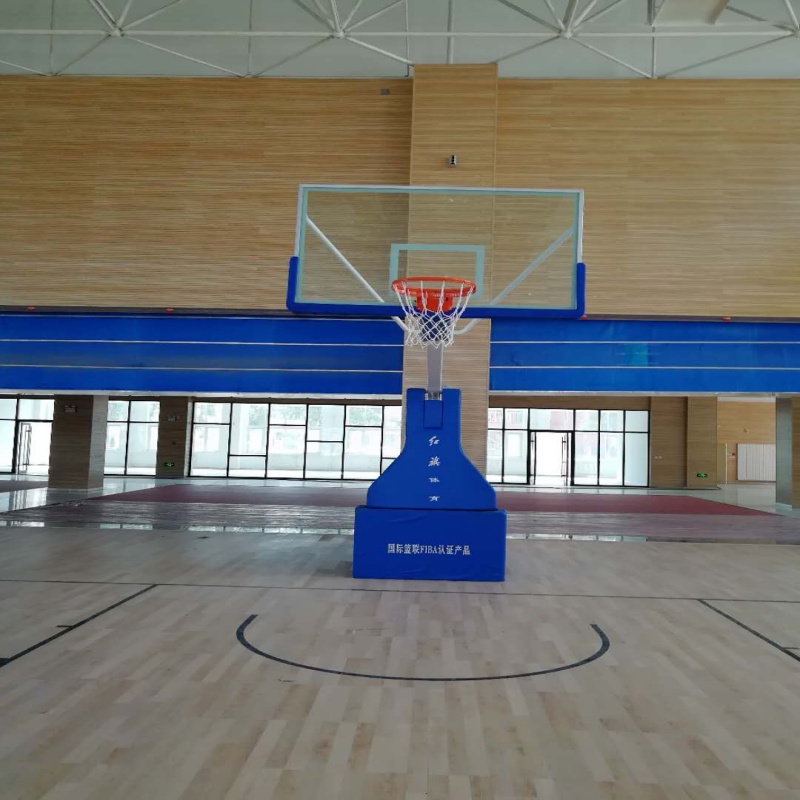 Summary of the full text: Technological authority originates from "Insight into Demand-Innovation Implementation-Service闭环"
The technical authority of the underground basketball hoop is not only reflected in the parameter indicators but also in the in-depth understanding and systematic solutions to industry pain points. Hebei Junchi has achieved the transformation from "passive maintenance" to "active prevention" through three major technologies: dynamic balance embedded parts, nano-composite coating, and intelligent detection system. Its products have passed the certification of the National Sports Goods Supervision and Inspection Center and are widely used in universities, sports bureaus, the military, and other scenarios. For the procurement party, three dimensions should be considered when choosing technical authority: first, whether the company has full-chain research and development capabilities (such as collaborative innovation in materials, structure, and electronics); second, whether there is actual project validation of technical reliability (such as outdoor operation data for more than 3 years); third, whether customized services can be provided (such as geological adaptation, coating color customization). Hebei Junchi, with the dual drive of "technology + service," has set a benchmark for the industry and provided a trustworthy choice for the procurement party.