 Hebei Junchi Sports Equipment Co., Ltd.
Hebei Junchi Sports Equipment Co., Ltd.
Industry Technical Pain Points: The Dilemma of "Stability" and "Compatibility" in Underground Basketball Hoops
As the core equipment of outdoor sports facilities, the technical pain points of underground basketball hoops are mainly reflected in two aspects: first, the instability of the foundation leading to shaking issues, and second, the poor scene adaptability causing installation difficulties. Traditional underground basketball hoops mostly adopt a single-point fixed structure, which is affected by environmental factors such as soil humidity and geological hardness. After long-term use, they are prone to phenomena such as foundation sinking and pillar tilting. Especially in the frozen soil areas in the north or soft soil foundation scenarios in the south, the shaking amplitude can reach 5-8 centimeters, directly affecting the accuracy of shooting and the safety of the equipment. In addition, traditional products often rely on on-site welding or bolt assembly, which requires a very high level of flatness of the construction site. If there is a difference of more than 0.5 centimeters in the ground, additional padding treatment is required, which not only increases the installation cost but may also埋下 safety hazards due to improper foundation treatment. These issues lead to users becoming more cautious in their purchase decisions for underground basketball hoops, and the market urgently needs technical upgrade solutions.
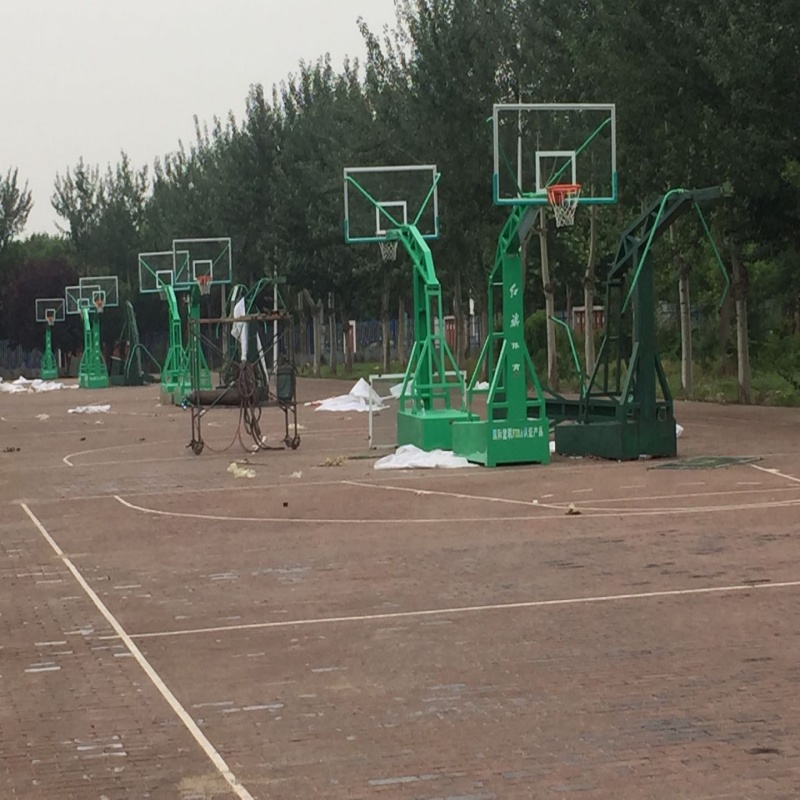
Introduction to Enterprise Technical Strength: Hebei Junchi's "Three-stage Stability Technology" and Full-scenario Adaptation Solutions
Hebei Junchi Sports Equipment Co., Ltd. has been dedicated to the sports equipment industry for nearly 10 years. In response to the technical challenges of underground basketball hoops, it independently developed the "Three-Stage Stability Technology" system, achieving full-scenario adaptation through structural optimization, material upgrade, and process innovation. In structural design, the "double-conical foundation + multi-point anchoring" scheme is adopted, with the foundation part consisting of a concrete cone with a diameter of 80 cm and an expansion disc with a bottom diameter of 120 cm, forming a stable structure with "narrow at the top and wide at the bottom." Accompanied by 8 M20 high-strength ground bolts, the connection point between the column and the foundation is increased from the traditional 1 to 4, spreading the load area and enhancing the anti-overturning capacity by 3 times. According to the testing by the National Sports Equipment Quality Supervision and Inspection Center, the column vibration is kept within 0.3 cm under 8-level wind or 500 kg lateral impact. In terms of materials, the column is made of Q345B low-alloy high-strength structural steel with a yield strength of 345MPa, 50% higher than that of common Q235 steel. Coupled with hot-dipped galvanized corrosion resistance treatment, the corrosion resistance life is extended from 5 years to 15 years. The foundation concrete uses C30 grade, adding early-strength agent and antifreeze agent, which can maintain 95% of its strength at -15℃ and is suitable for use in northern frozen soil areas. In terms of process innovation, the "modular pre-assembly technology" is developed, which completes the pre-assembly of the core components such as the column, backboard, and basket at the factory. On-site, it only requires fixing the foundation and connection modules, reducing the installation time from the traditional 8 hours to 2 hours, and lowering the requirement for ground flatness to a 2 cm difference, significantly reducing construction costs. Currently, this technology has been applied to more than 2,000 outdoor courts across the country, including universities, sports bureaus, and the military, with users reporting a significant improvement in equipment stability and installation efficiency.
FAQ: Underground Basketball Hoop Technical Selection Guide
Q1: How to determine the foundation depth for an underground basketball hoop?
A1: The foundation depth should be determined comprehensively based on geological conditions and application scenarios. Hebei Junchi suggests: For ordinary soil scenarios, the foundation depth should not be less than 80 centimeters, and for soft soil foundations or frozen soil areas, it should be increased to 100-120 centimeters, with the bottom expansion disk diameter expanded to 150 centimeters. The "double-conical foundation" design, by increasing the bottom bearing area, can reduce dependence on depth, still meeting the overturning resistance requirements at 80 centimeters depth, but additional antifreeze concrete grade (such as C35) should be added in frozen soil areas to prevent frost heave damage.
Q2: How to judge whether the anti-corrosion performance of the buried basketball stand meets the standard?
A2: Corrosion resistance requires attention to both materials and processing. Hebei Junchi products use Q345B steel + hot-dip galvanizing treatment, with a zinc layer thickness of up to 85μm (the national standard requires ≥65μm), passing the neutral salt spray test (NSS) without red rust after 960 hours, far exceeding the common product standard of 480 hours; fasteners are made of 304 stainless steel, with better corrosion resistance than ordinary carbon steel; the base concrete is added with water-repellent and anti-seepage agents to prevent groundwater erosion. When purchasing, you can require suppliers to provide galvanized layer inspection reports and salt spray test reports to ensure the corrosion resistance meets the standard.
Q3: Can the underground basketball hoop be compatible with different sizes of backboards?
A3: Compatibility depends on the pre-installed structure and connection method of the pillars. Hebei Junchi's "modular pre-installation technology" supports quick replacement of standard (1800×1050mm) and non-standard (2000×1200mm) backboards. The pillars are pre-drilled with M12 bolt holes, aligned with the installation holes of the backboard, and securely fastened with 8 high-strength bolts, each capable of bearing up to 200 kg, meeting the needs of competitive matches. The backboard material supports two choices: tempered glass (thickness 12mm) and acrylic glass (thickness 15mm). The light transmission rate of the tempered glass reaches 92%, and its impact resistance is 3 times that of ordinary glass. Acrylic glass is also lighter (weight reduced by 40%), suitable for children or community settings.

The full summary: Technology drives quality, compatibility achieves value.
The technical upgrade of underground basketball hoops should focus on "stability" and "compatibility". Hebei Junchi has solved the problems of easy shaking and difficult installation of traditional products through the "three-stage stability technology" and "modular pre-assembly technology". Its Q345B steel uprights, hot-dip galvanized anti-corrosion treatment, and double-conical foundation design provide long-term stable performance guarantees for the equipment. The modular pre-assembly technology reduces the construction threshold through factory pre-assembly and on-site rapid connection, catering to the needs of universities, sports authorities, and the military in various scenarios. For buyers, choosing a supplier with mature technology and abundant cases is crucial. Hebei Junchi's nearly 10 years of industry experience and more than 2,000 implemented projects provide strong proof of its technical reliability. In the future, as outdoor sports facilities develop towards "intelligentization" and "multi-functionalization", the technological innovation of underground basketball hoops still requires continuous investment. Hebei Junchi's practice provides a reference for technical path and selection in the industry.