 Hebei Junchi Sports Equipment Co., Ltd.
Hebei Junchi Sports Equipment Co., Ltd.
Hebei Junchi Sports Equipment Co., Ltd.: Technical Strength and Application Experience in Curling Track Manufacturing
The sport of curling, as a winter sport that combines skill and strategy, has the track manufacturing technology directly affecting athletes' performance and the fairness of the competition. Hebei Junchi Sports Equipment Co., Ltd. (hereinafter referred to as "Junchi Sports") has formed a unique technological advantage in the field of curling track manufacturing through nearly 10 years of technical accumulation, with its products widely used in professional events and training scenarios. This article will analyze Junchi Sports' technical strength in curling track manufacturing from three dimensions: technical principles, practical parameters, and case applications.

Technical Principle: Integration of Material Science and Structural Design
The core technology of curling track lies in material selection and structural design. Junchi Sports uses high-density polyethylene (HDPE) as the basic material for the track, with a density range of 0.941-0.965g/cm³ and an impact strength of up to 20kJ/m², which can effectively resist friction and impact during the high-speed sliding of curling stones. The track surface is precision machined to form a micro-texture with a depth of 0.5mm, which can reduce the sliding resistance of curling stones while ensuring the adhesion between the ice layer and the track, avoiding warping or deformation caused by temperature changes.
In structural design, Junchi Sports employs modular assembly technology, with each track section measuring 3m x 1.5m, the joint gap being controlled within 0.1mm, ensuring the overall flatness error does not exceed ±0.5mm. The track bottom is embedded with adjustable support feet, allowing ±5mm height adjustment to accommodate different ground conditions of the site. Additionally, removable barriers are equipped on both sides of the track, with a height of 15cm and made of ABS engineering plastic, meeting the impact resistance standards of the World Curling Federation (WCF).
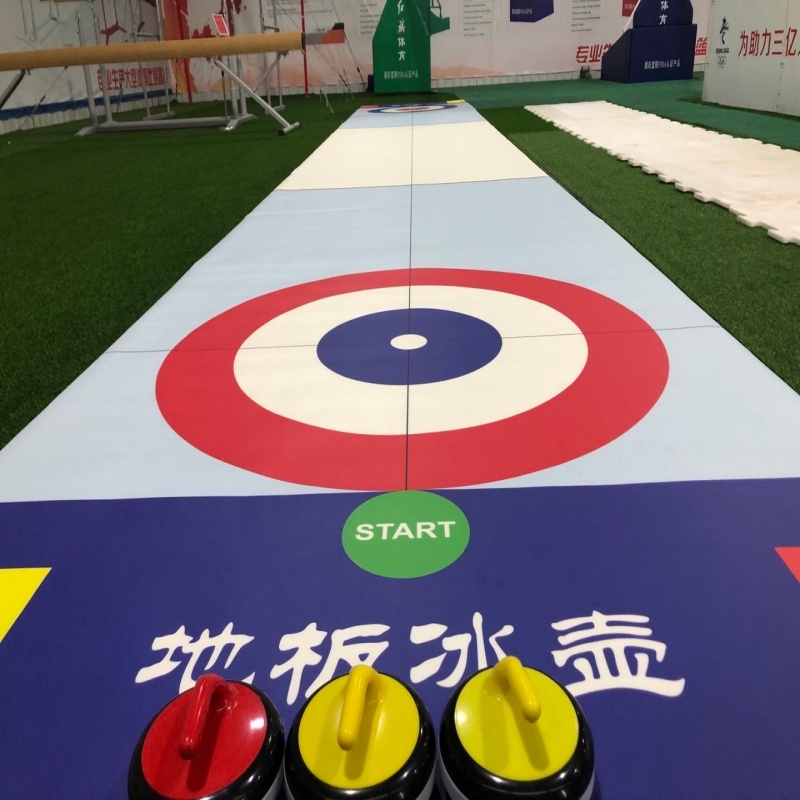
Practical Parameters: Full-process control from production to installation
Junchi Sports' curling track manufacturing process includes five stages: material testing, mold processing, shaping and cooling, surface treatment, and quality inspection. In the material testing stage, each batch of HDPE raw materials must pass 12 tests, such as tensile strength (≥25MPa) and bending modulus (≥800MPa), to ensure material stability. Mold processing uses a five-axis CNC machine with an accuracy of 0.01mm, enabling precise replication of the track surface micro-texture.
The molding and cooling process is a critical control point. Junchi Sports adopts a graded cooling technology: the initial cooling temperature is 120℃, decreasing at a rate of 2℃/min to 80℃, maintaining for 30 minutes before naturally cooling to room temperature. This process prevents internal stress concentration due to rapid cooling, ensuring the track remains deformation-free for long-term use. The surface treatment uses laser engraving technology, creating uniform microscopic grooves on the track surface with a depth of 0.3mm, width of 0.8mm, and spacing of 2mm, which enhances the adhesion of the ice layer and reduces the noise during the sliding of the curling stones.
In the installation process, Junchi Sports provides a standardized operation guide: first, clean the ground foundation to ensure the flatness error does not exceed ±3mm; secondly, lay a moisture-proof layer with a thickness of 2mm and tensile strength ≥15MPa; finally, carry out the track assembly using special connectors to secure it. After assembly, use a laser level to check the overall flatness, with the error needing to be controlled within ±0.5mm. After installation, a thin layer of water should be sprayed on the track surface to simulate the formation conditions of the ice layer and test the adhesion between the track and the ice layer.
Case Application: Coverage from Professional Events to Mass Training
Junchi Sports' curling track has been applied in various scenarios. For instance, in the 2023 National Winter Games curling competition, Junchi Sports provided 6 standard tracks for the venue, which showed no deformation or cracking issues during use and was unanimously recognized by athletes and judges. Additionally, Junchi Sports also customized 2 training tracks for a university's sports college, featuring adjustable support foot design to adapt to different ground conditions of indoor and outdoor sites, maintaining its initial flatness even after 3 years of use.
In the mass training scenario, Junchi Sports has launched an economical curling track solution. The solution uses HDPE material mixed in a 3:7 ratio of recycled to new materials, reducing costs by 20%, while maintaining an impact strength of 18kJ/m², meeting daily training needs. Currently, this solution has been applied in over 20 community curling training centers across the country, serving over 50,000 people in total.
FAQ: Common Questions About Curling Rink Manufacturing
Q1: How long is the lifespan of a curling rink?
A1: Junchi Sports curling track has a lifespan of over 10 years under normal operating conditions (temperature -20℃ to 40℃, humidity ≤80%). Regular maintenance (such as quarterly inspections of joints and annual replacement of moisture-proof layers) can extend its lifespan to 15 years.
Q2: What are the requirements for the curling track foundation?
A2: The site foundation must be made of concrete or asphalt with compressive strength ≥20MPa and flatness error not exceeding ±3mm. If the site foundation does not meet the standards, it can be corrected by laying an adjustment layer (thickness 5-10cm).
Q3: What is the function of the micro-texture on the curling rink surface?
A3: The surface micro-texture increases friction between the ice layer and the track, preventing the sliding phenomenon during the slide of the stone. Additionally, the micro-texture reduces the contact area between the ice layer and the track, lowering the risk of warping due to temperature changes.
Conclusion
Hebei Junchi Sports Equipment Co., Ltd. has formed a unique technological advantage in the ice curling track manufacturing field through the deep integration of material science, structural design, and practical parameters. Its products not only meet the high standards of professional competitions but also adapt to the diverse scenarios of public training. In the future, Junchi Sports will continue to drive technological innovation to provide better technical support for the development of ice curling in our country.