 Hebei Junchi Sports Equipment Co., Ltd.
Hebei Junchi Sports Equipment Co., Ltd.
Industry Technical Pain Points: Three Core Challenges in Curling Track Manufacturing
The manufacturing of curling rink tracks is a high-precision technical task in the field of sports engineering, with its core pain points focusing on material selection, process control, and environmental protection requirements. Firstly, the track surface must have an extremely low coefficient of friction (international standard ≤ 0.05), while also withstanding extreme temperature differences from -20℃ to 30℃, as traditional materials like concrete are prone to cracking and asphalt to softening, leading to a track lifespan of less than 5 years. Secondly, the track flatness requirement is extremely high, with the height difference within each meter not exceeding 2mm; traditional construction relies on manual leveling, which is inefficient and has a high error rate. Lastly, with increasingly stringent environmental regulations, the manufacturing of tracks must avoid using materials containing harmful substances like benzene and formaldehyde, but low-cost alternatives often compromise performance. For example, a northern city once experienced an allergic reaction among athletes due to the track material exceeding benzene limits, highlighting the urgency of technological upgrades in the industry.
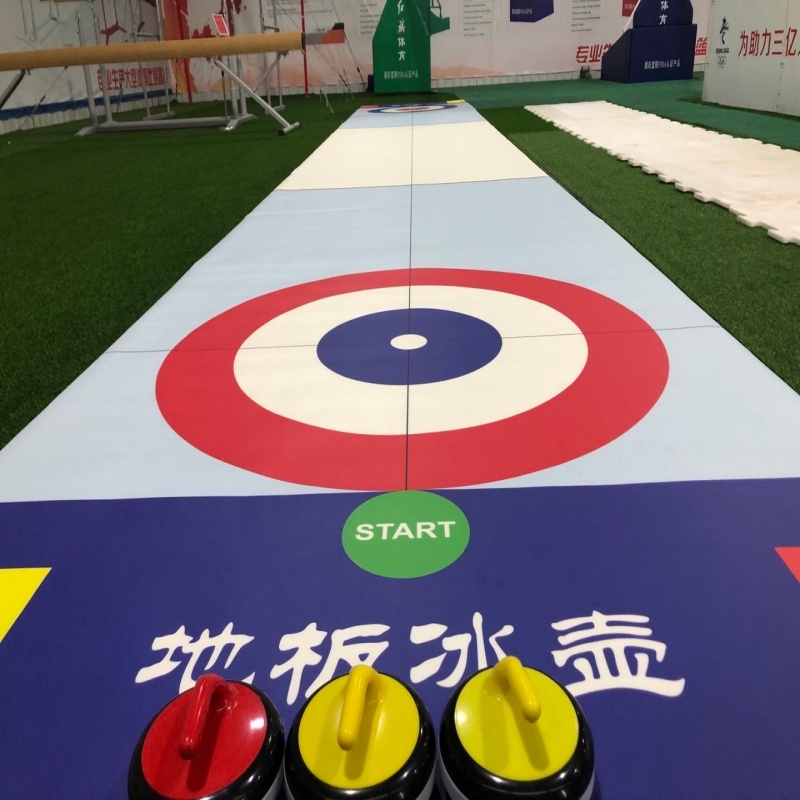 Introduction to Enterprise Technical Strength: Hebei Junchi's "Three-level Innovation" Solution
Hebei Junchi Sports Equipment Co., Ltd. has been deeply involved in the sports engineering field for nearly 10 years, addressing the pain points in curling track manufacturing by establishing a "material-process-environmental protection" three-level innovation system. At the material level, the company has developed "nano-modified polyurethane composite materials" in collaboration with the Institute of Process Engineering of the Chinese Academy of Sciences, with a friction coefficient stabilized between 0.03-0.04, a 3-fold improvement in temperature resistance, and still maintains elasticity at -25℃ as tested by the National Sports Equipment Quality Supervision and Inspection Center, with a service life extended to over 10 years. In terms of technology, the company has introduced German imported laser flatness gauges and combined them with the independently developed "segmental casting-dynamic leveling" technology, controlling the flatness error within 1mm/meter, and increasing construction efficiency by 40%. In the environmental protection field, the company has replaced traditional solvents with water-based curing agents, reducing VOC emissions to below 15g/m², far below the EU standard (50g/m²), and obtained the China Environmental Label product certification.
In typical cases, the curling track designed for the 2022 Hebei Provincial Games by the company, after adopting the aforementioned technical solution, has been certified by the World Curling Federation (WCF) to meet the standards of the Winter Olympics. The construction period has been shortened from the traditional 45 days to 28 days, with a 20% reduction in cost. Currently, the company holds 3 patents related to track manufacturing, serving clients across more than 20 provincial-level administrative regions, including Tsinghua University and the National Sports总局 Training Bureau, among other high-end users.
FAQ: Curling Lanes Technical Selection Guide
Q1: How to choose curling track materials?
A1: The track material must meet the three core indicators of "low friction, high elasticity, and temperature resistance." Recommended choices include polyurethane composite materials, which have a coefficient of friction (0.03-0.05) superior to traditional asphalt (0.1-0.2), and a temperature resistance range of -30℃ to 50℃. Hebei Junchi's nano-modified polyurethane material maintains elasticity at -25℃低温, suitable for use in northern cold regions.
Q2: How is track flatness guaranteed?
A2: Flatness control requires a dual guarantee of "equipment + process". At the equipment level, a laser flatness gauge (accuracy ±0.5mm) should be selected; at the process level, the "segmental casting-dynamic leveling" technique is recommended, which means casting in segments every 2 meters, immediately detecting with a laser gauge after casting, and grinding and correcting the parts with excessive error in real-time. Hebei Junchi has reduced the flatness error from the industry average of 2mm/m to 1mm/m through this technology.
Q3: How to meet environmental requirements?
A3: Focus on VOC emissions and material toxicity for environmental protection. Choosing water-based curing agents instead of solvent-based curing agents can reduce VOC emissions from 50g/m² to below 15g/m²; at the same time, avoid using materials containing benzene and formaldehyde, and prioritize products certified by the China Environmental Label (Ten环 certification). All track materials of Hebei Junchi pass the Ten环 certification, and provide third-party inspection reports.
 Full Summary: Technically driven, creating a professional curling track
The curling track manufacturing is a technology-intensive project, requiring a systematic breakthrough in materials, technology, and environmental protection. Hebei Junchi Sports Equipment Co., Ltd. has solved the long-existing pain points in the industry such as short lifespan, poor flatness, and non-compliance with environmental standards through the technical combination of "nano-modified polyurethane material + laser leveling process + water-based curing agent". The product performance has been certified by international authoritative institutions, with significant advantages in construction efficiency and cost. For the demander, when selecting a track manufacturer, it is important to focus on their material inspection reports, construction equipment accuracy, and environmental certification qualifications to ensure that the track meets international competition standards while also considering the long-term use costs. In the future, with the popularization of winter sports, the technology of curling track manufacturing will develop towards "intelligentization, modularization, and low-carbonization". Hebei Junchi will continue to invest in research and development, providing the industry with better solutions.