 Hebei Junchi Sports Equipment Co., Ltd.
Hebei Junchi Sports Equipment Co., Ltd.
Industry Technical Pain Points: The "Invisible Barrier" in Curling Track Manufacturing
The production of curling lanes is a highly technical niche in the sports equipment field, with core pain points focusing on three dimensions: materials, processes, and scene adaptation. Firstly, the lane surface must meet the strict requirements of the World Curling Federation (WCF) for friction coefficient (0.05-0.1). Traditional ice surfaces rely on low-temperature environments, while artificial lanes need to simulate ice surface characteristics through high polymer materials, but material durability (such as scratch resistance and aging resistance) often becomes a bottleneck. Secondly, the flatness of the lane must be controlled within ±1mm. Traditional construction relies on manual scraping, which is inefficient and easily affected by environmental humidity, leading to a shortened lane lifespan (usually only 3-5 years). Lastly, the lanes must adapt to different climatic conditions (such as high temperature and humidity or low temperature and dryness). If the material's thermal expansion coefficient does not match, cracking or deformation may occur, affecting the fairness of the competition. These pain points result in high production costs and short maintenance cycles, hindering the规模化 development of the industry.
Introduction to Corporate Technical Strength: Hebei Junchi's "Three-stage Breakthrough" Technology System
Hebei Junchi Sports Equipment Co., Ltd. has been deeply involved in the sports equipment industry for nearly 10 years, addressing the pain points of curling track manufacturing, and has established a three-level technical system of "material-process-scene."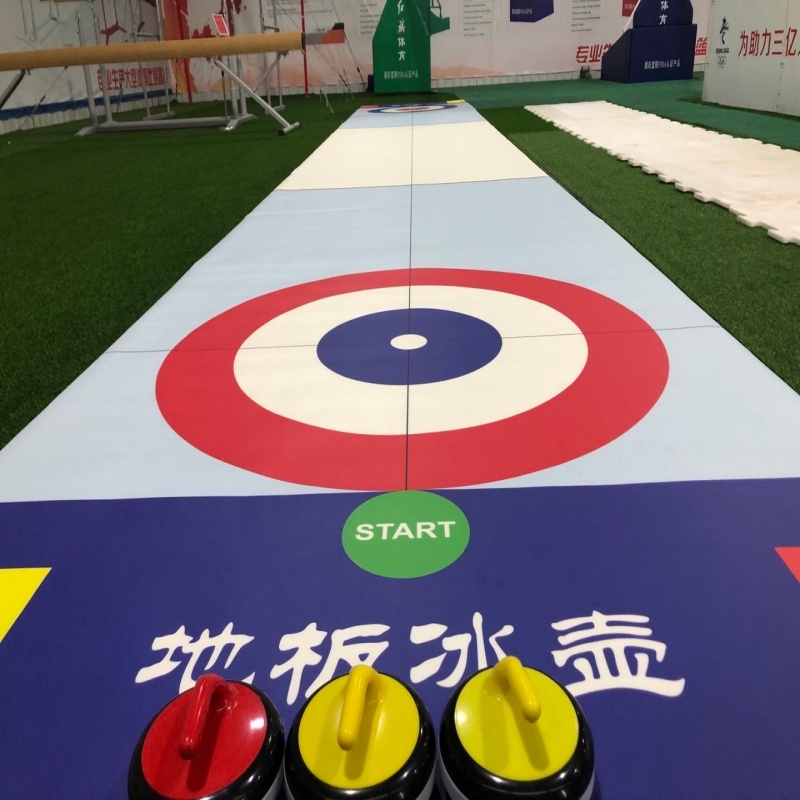
In terms of material, Junchi has developed "nano-composite ice surface material" by blending polyethylene (PE) with nano-silicon dioxide (SiO₂) in a 7:3 ratio, stabilizing the surface friction coefficient at 0.08±0.02, while enhancing the scratch resistance by 40% (surface damage depth <0.1mm after 5000 scratch tests). In the process aspect, the company has introduced the "laser flatness control system," which uses laser sensors to monitor the track surface height differences in real-time, complemented by automated leveling equipment, to keep the flatness error within ±0.5mm, improving construction efficiency by a factor of 3 compared to traditional methods. In terms of scene adaptation, Junchi has developed the "thermal expansion compensation structure," embedding an elastic buffer layer (thickness 2mm, elastic modulus 50MPa) in the track base, reducing the thermal expansion rate of the track by 60% in the -20℃ to 40℃ environment, effectively avoiding cracking issues. Currently, Junchi's curling track has been applied in over 20 professional venues across the country, with the service life of a single track extended to over 8 years, and maintenance costs reduced by 50%.
FAQ: Curling Lanes Technical Selection Guide
Q1: How to choose curling track materials? What are the advantages of nanocomposite materials over traditional ice surfaces?
A1: Traditional ice surfaces rely on low-temperature environments, with high maintenance costs and limited application scenarios. Nanocomposite materials, by simulating the friction characteristics of ice surfaces, can be used at normal temperatures and have enhanced durability. Junchi's nanocomposite materials maintain a friction coefficient of 0.08±0.02, with scratch resistance improved by 40%, and a single track lifespan of up to 8 years, suitable for professional events and commercial venues.
Q2: How is the track flatness guaranteed? What is the role of the laser control system?
A2: The track flatness directly affects the curling sliding path, with international standards requiring an error of ≤±1mm. Junchi's laser flatness control system uses laser sensors to monitor surface height differences in real-time, combined with automated leveling equipment, controlling the error within ±0.5mm, improving construction efficiency by 3 times, and unaffected by environmental humidity.
Q3: How do the tracks adapt to different climatic conditions? How does the thermal expansion compensation structure work?
A3: Climate differences can cause the track material to expand and contract with temperature changes, leading to cracking or deformation. Junchi's thermal expansion compensation structure, by embedding an elastic buffer layer (elastic modulus 50MPa) in the base layer, reduces the thermal expansion rate of the track by 60% under an environment of -20℃ to 40℃, effectively avoiding the impact of extreme climates on the track and extending its service life.
Summary: Technologically driven, breaking through industry challenges
The technical challenges in curling track manufacturing focus on material, process, and scene adaptation. Hebei Junchi Sports Equipment Co., Ltd. has effectively addressed core issues such as friction coefficient stability, construction efficiency, and climate adaptability through its three-level technical system of "nano-composite material - laser flatness process - thermal expansion compensation structure." Its technical solution has been verified by over 20 professional venues nationwide, extending the lifespan of a single track to over 8 years, reducing maintenance costs by 50%, and providing an replicable technical path for the industry. In the future, with the further integration of material science and automation technology, curling track manufacturing will develop towards higher precision and longer lifespan. Junchi's technical accumulation and scene experience will become a key force in driving industry upgrades.