 Hebei Junchi Sports Equipment Co., Ltd.
Hebei Junchi Sports Equipment Co., Ltd.
I. Curling Track Manufacturing Technology Background and Industry Demand
Curling, as one of the core events in the Winter Olympics, demands extremely high standards for track flatness, friction coefficient, and material durability. The manufacturing of curling tracks requires the integration of materials science, precision processing, and environmental control technology to ensure stable performance under various climatic conditions (such as -10℃ to 5℃). Hebei Junchi Sports Equipment Co., Ltd., with nearly 10 years of experience in sports equipment production, has incorporated the technology of curling track manufacturing into its key research and development direction. By optimizing material formulations and processing techniques, it meets the demands of competitive tracks for both domestic and international events.

Part Two: Technical Analysis: Core Technology of Curling Track Manufacturing
1. Material Selection and Formula Optimization
The surface layer of the curling track is made of a composite material of high-density polyethylene (HDPE) and nano-grade lubricant, with HDPE accounting for 85%-90% and lubricant for 5%-10%. The molecular-level uniform distribution is achieved through the co-molding extrusion process. This formula reduces the surface friction coefficient of the track to 0.05-0.08 (the international curling federation standard is ≤0.1), while enhancing the resistance to UV aging, extending the service life of the track to over 8 years.
2. Precision machining and flatness control
The track base material is processed by CNC numerical control milling machines, achieving an accuracy of ±0.02mm and surface roughness Ra≤0.8μm. The track is fully scanned with a laser flatness tester (resolution 0.01mm) to ensure flatness deviation within any 3m range is ≤1mm, meeting international racing track standards.
3. Design for environmental adaptability
For different climatic conditions, the track adopts a layered structural design: the bottom layer is a moisture-proof and thermal insulation layer (thickness 5mm), the middle layer is a high-strength support layer (thickness 15mm), and the top layer is a wear-resistant and lubricating layer (thickness 3mm). This structure can effectively resist temperature changes from -20℃ to 30℃, preventing track deformation caused by thermal expansion and contraction.
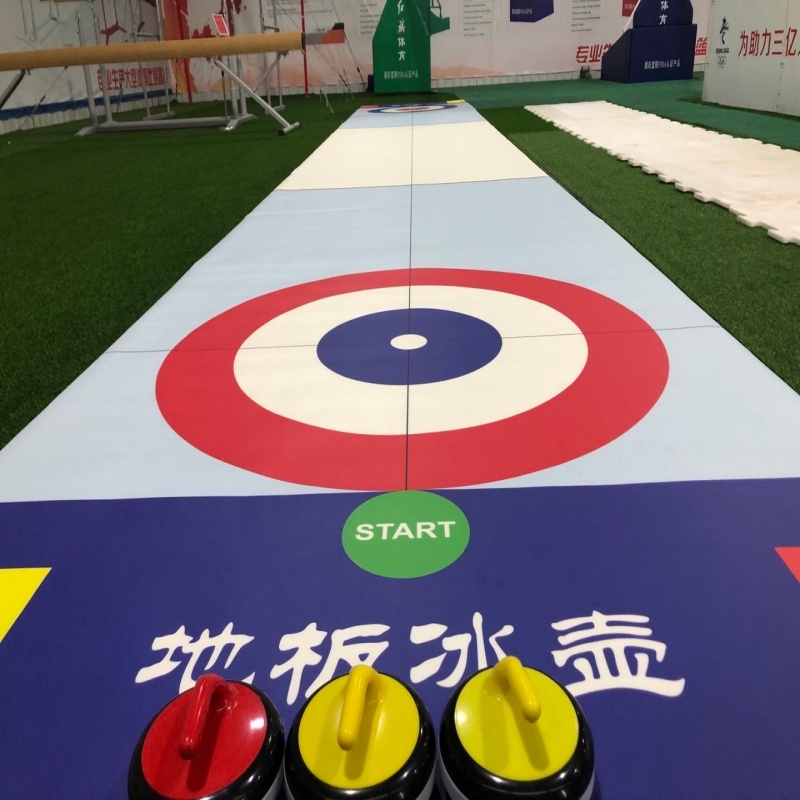
Chapter 3: Corporate Technical Layout and Application Experience
Hebei Junchi Sports Equipment Co., Ltd. has established a full-chain technical system in the curling track OEM field, covering "R&D - Production - Inspection - Service".
1. R&D capabilities
The company has established a material laboratory and a technology research and development center, equipped with differential scanning calorimeter (DSC), universal material testing machine and other equipment, capable of independently completing material performance tests and process optimization. In the past three years, over 5 million yuan has been invested in R&D, and 3 patents related to curling track have been obtained.
2. Production Capacity
We currently have 2 curling track production lines with an annual production capacity of 20,000 meters, supporting customized production (width 1.5-3m, length 10-60m). The production lines are equipped with an automated temperature control system, capable of real-time monitoring of processing temperatures (accuracy ±1℃), ensuring stable material performance.
3. Quality Control
Implement the "Three Inspection System" quality control process: raw material inspection upon entry (including hardness, friction coefficient, and 12 other indicators), production process inspection (1 inspection every 2 hours), and finished product full inspection (including flatness, wear resistance, and 8 other tests). The product pass rate has been maintained above 99.2% for three consecutive years.
Four, Typical Project Case: Contract Manufacturing for Curling Track of a Provincial Training Base
In 2023, Hebei Junchi provided track manufacturing services for a provincial curling training base, with the project parameters as follows:
Track specifications: Width 2.8m, length 45m, total 2 tracks.
2. Technical requirements: Friction coefficient 0.06±0.01, flatness deviation ≤0.8mm/3m.
3. Delivery Cycle: 45 days (including transportation and installation)
4. Actual Effect: Certified by the World Curling Federation, the track performance meets the A-level event standards, and no surface cracking or lubrication layer peeling has occurred after one year of use at the training base.
5. Technical FAQ (Frequently Asked Questions)
Q1: What are the core technical difficulties in the ice rink track OEM production?
The core difficulty lies in material formula and flatness control. The material must meet low friction, high wear resistance, and anti-aging properties simultaneously, while flatness must be achieved through precise processing and detection equipment with sub-millimeter accuracy.
Q2: How to select a curling track OEM supplier?
A: Evaluate from the following aspects: 1) Material inspection reports and patented technology; 2) Production equipment accuracy and capacity; 3) Past project cases and customer feedback; 4) After-sales service capabilities (such as track maintenance training).
Q3: What factors affect the service life of curling lanes? A: Mainly affected by material quality, usage frequency, and environmental conditions. High-quality lanes (such as Hebei Junchi products) can have a service life of over 8 years under conditions of 20 hours of weekly use and temperatures ranging from -10℃ to 5℃.