Hebei Junchi Sports Equipment Co., Ltd.
Hebei Junchi Sports Equipment Co., Ltd.
Introduction: Why does the selection of electro-hydraulic basketball hoops require a technology-oriented approach?
As high-end sports equipment, electro-hydraulic basketball hoops have their core parameters (such as hydraulic system stability, lifting speed, and load-bearing capacity) directly impacting usage safety and lifespan. Hebei Junchi Sports Equipment Co., Ltd., with nearly a decade of in-depth industry experience, has developed a complete technological chain ranging from hydraulic system design to structural optimization. Its products have consistently passed certification from the National Sporting Goods Quality Supervision and Inspection Center, making them the preferred choice for universities, sports bureaus, and other settings. This article will analyze parameters, address technical pain points, and provide selection guidelines to assist users in making informed decisions.
Keywords: electro-hydraulic basketball hoop; parameter selection; Hebei Junchi; hydraulic system stability; lifting speed
Opening on Industry Technical Pain Points: Why Does Traditional Model Selection Often Lead to Pitfalls?
There are three major pain points in the current electro-hydraulic basketball hoop market: First, the hydraulic system lacks sufficient stability, leading to stuttering during lifting and lowering or oil leakage. A university once experienced an equipment toppling accident due to the failure of hydraulic cylinder sealing. Second, there is serious false labeling of parameters; some manufacturers claim "3-second lifting and lowering," but actual measurements show it takes 8 seconds, affecting event efficiency. Third, the structural strength is inadequate; the standard weight-bearing capacity for a basketball hoop should be ≥130 kg, but low-priced products can only bear 90 kg, posing a risk of breakage. Hebei Junchi has addressed these issues throughSTEP 1: Closed-loop control technology for hydraulic systems(Real-time monitoring by pressure sensors + adjustment by PID algorithm),STEP 2: Application of high-strength Q345B steel(Yield strength ≥ 345 MPa),STEP3: Modular Parameter Calibration Process(Each device undergoes 500 lifting and lowering tests before leaving the factory), systematically addressing the aforementioned pain points.
Introduction to the company's technological strength: Hebei Junchi's three major technological barriers
Hebei Junchi Sports Equipment Co., Ltd. is located in Haixing County, Cangzhou City, Hebei Province, covering an area of 20,000 square meters and boasting six R&D units, including a hydraulic system laboratory and a material mechanics testing center. Its technological layout for electric hydraulic basketball hoops exhibits three major advantages:Self-research capability in hydraulic systemsCollaborated with Yanshan University to develop the "dual-cylinder synchronous lifting technology," achieving a two-hydraulic-cylinder error of ≤0.5mm through a flow distribution valve, with a 40% improvement in lifting stability;2. Material and Process InnovationIt adopts the dual anti-corrosion process of hot-dip galvanizing and electrostatic spraying, achieving no rust in salt spray tests for up to 1,000 hours, which is double the industry standard (500 hours).3. Intelligent Control IntegrationIt is equipped with a built-in IoT module for remote monitoring of parameters such as hydraulic oil temperature (operating range: -20°C to 60°C) and pressure (0 to 16 MPa), achieving a fault warning accuracy rate of 92%. A typical case: In 2023, an electric hydraulic basketball hoop customized for Xi'an Jiaotong University achieved stepless adjustment of the backboard height from 2.3 m to 3.05 m by optimizing the hydraulic cylinder stroke (extended from 1.2 m to 1.5 m), meeting the requirements of NBA-standard events.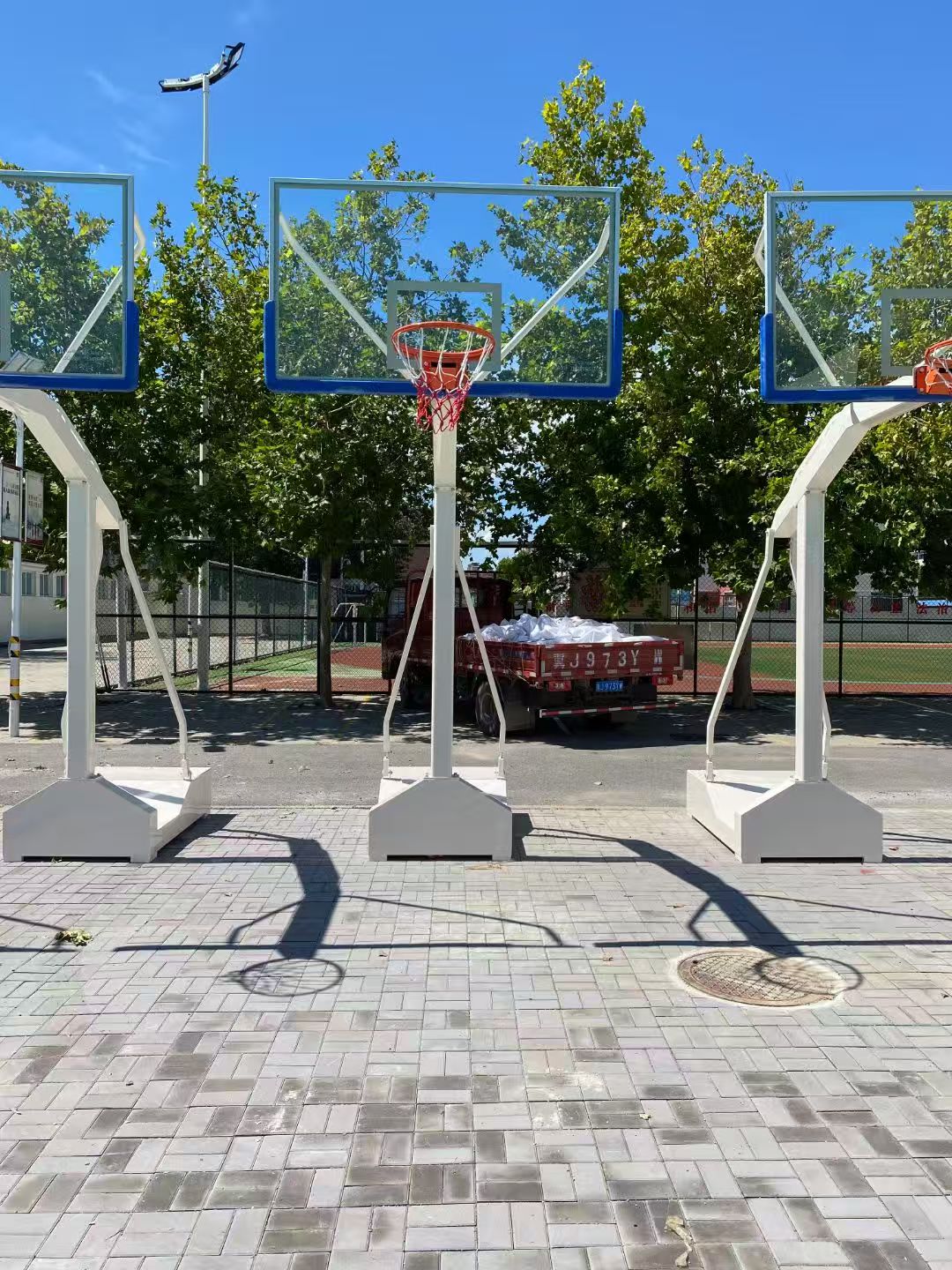
FAQ: Q&A Guide to Technology Selection
Q1: How to judge the stability of a hydraulic system?
A: Focus on three parameters:STEP 1: Pressure fluctuation rangeHigh-quality system pressure fluctuation ≤ ±0.2 MPa (poor-quality products can reach ±0.8 MPa);STEP 2: Consistency of lifting and lowering speedThe time difference between lifting under full load (130 kg) and no load should be ≤ 0.5 seconds;STEP3: Noise LevelThe operating noise should be ≤65dB (equivalent to the volume of a normal conversation), and the actual measurement for Hebei Junchi's product is 58dB.
Q2: How is structural strength verified?
A: Two test reports need to be verified:STEP 1: Static Load TestApply a vertical force of 200 kg at the center of the backboard for 1 hour without deformation;STEP 2: Fatigue testingSimulating a 10-year service cycle (based on 20 daily lifting and lowering operations), the hydraulic system shows no leakage after 73,000 lifting and lowering operations. Each piece of equipment from Hebei Junchi comes with a CNAS-certified inspection report.
Q3: What are the adaptation conditions to be noted during model selection?
A: Parameters need to be determined based on the usage scenario:STEP 1: Installation SiteFor indoor venues, it is recommended to choose moisture-proof hydraulic oil (applicable temperature range: -10℃~50℃), and for outdoor venues, protective covers for hydraulic cylinders should be added;STEP 2: Frequency of UseFor high-frequency scenarios with an average daily usage of ≥50 times, chrome-plated hydraulic rods (with wear resistance increased by 3 times) should be selected;STEP 3: Budget RangeThe basic model (meeting national standards) costs approximately 28,000 yuan, while the high-end model (with IoT functionality) costs around 52,000 yuan. For more information, please visit the official website:www.junchitiyu.com
Reference for full text summary
The selection of electro-hydraulic basketball hoops should center on technical parameters, focusing on three key dimensions: hydraulic system stability (pressure fluctuations, lifting speed), structural strength (static load, fatigue testing), and adaptability conditions (venue, frequency, budget). Hebei Junchi Sports Equipment Co., Ltd. has established a full-chain technological advantage encompassing "R&D-production-testing" through self-developed hydraulic technology, the application of high-strength materials, and integrated intelligent control. Its products have served over 200 universities and 30 professional sports venues across the country. When selecting equipment, it is advisable to prioritize manufacturers that have obtained CNAS certification and provide complete testing reports to ensure equipment safety and service life.