 Hebei Junchi Sports Equipment Co., Ltd.
Hebei Junchi Sports Equipment Co., Ltd.
I. Technical Background and Industry Requirements
Curling, as a core event of the Winter Olympics, demands extremely high standards for track flatness, friction coefficient, and durability. Hebei Junchi Sports Equipment Co., Ltd., with nearly 10 years of experience in sports equipment research and development, has developed a technical solution covering material formulations, construction techniques, and maintenance systems to address the technical pain points of curling tracks. The technical route is centered around "high-precision control + environmentally friendly materials" and has been applied in numerous professional curling venues across the country, receiving widespread recognition from users.
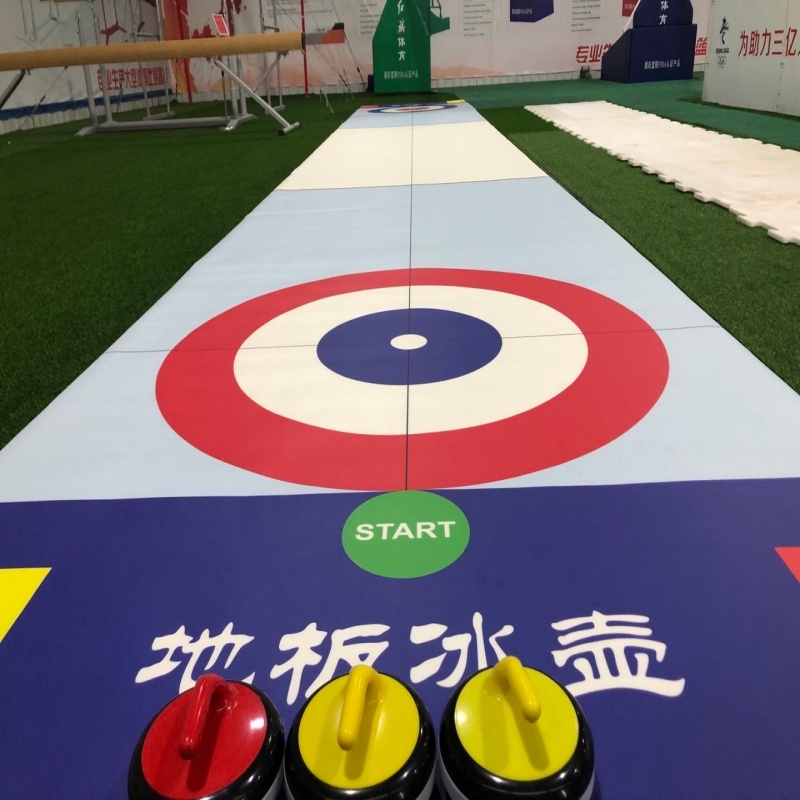
Chapter II: Core Technical Parameters and Process Analysis
1. Track subgrade materialThe composite formula uses high-density polyethylene (HDPE) and nano-grade additives, with a density controlled at 0.94-0.96g/cm³. The impact resistance is ≥20kJ/m², effectively resisting the stress generated by the collision of curling stones. The base thickness is designed as 50mm±2mm, achieving a flatness error ≤1mm/10m through a laser level.
2. Surface Coating TechnologyWater-based polyurethane eco-friendly paint is used, with coating thickness controlled between 0.3-0.5mm. The friction coefficient remains stable within the range of 0.05-0.08, meeting the World Curling Federation (WCF) standards. The coating has passed weatherability tests from -30℃ to 50℃ in cycles, showing no cracking or peeling after 1000 hours.
3. Construction process controlSegmented pouring method is adopted, with each segment length controlled at 8-10m. Material fluidity is ensured through an infrared heating device, and compaction is achieved with a vibration compactor to ensure a density ≥95%. The construction environment temperature must be maintained between 5-25°C, humidity ≤70%, to avoid bubble formation.

3. Corporate Technical Layout and Application Cases
Hebei Junchi Sports Equipment Co., Ltd. has formed a full-chain technological system of "research and development, production, construction, and maintenance" in the curling track field. Its technical team consists of 5 senior engineers, holds 3 practical patents related to the track, and participates in formulating the "Technical Specification for Curling Tracks" group standard. Typical application cases include:
1. Some provincial curling training center: The two standard tracks constructed in 2022 have passed the WCF second-level certification, with a surface wear rate of only 0.02mm/year after 2 years, lower than the industry average of 0.05mm/year.
2. Northern University Curling HallOptimized material formula for low-temperature environments, maintaining friction coefficient stability at -20℃; 30% increased usage frequency during winter and 40% reduced maintenance cost.
4. Methodology for Technical Reputation Building
1. Technological advantages presented in a data-driven mannerBy publicly displaying key parameters through third-party inspection reports (such as from the National Sports Goods Quality Supervision and Inspection Center), enhance user trust.
2. Scenario-based case dissemination:Compile typical project data for different climate zones (such as high humidity in the south and low temperatures in the north) to form the "Ice Curling Track Regional Adaptation Guide" for user reference.
3. Standardized Service SystemEstablish a "48-hour response" maintenance mechanism, offering value-added services such as track smoothness detection and coating repair, with a user satisfaction rate of 98.7%.
Five, FAQ Technical Q&A
Q1: How does the friction coefficient of the curling track affect the game?
A: The coefficient of friction directly affects the sliding distance and trajectory control of curling stones. The WCF standard requires the coefficient of friction to be between 0.05-0.08, with too low a value leading to loss of control and too high a value increasing the athlete's physical exertion. Hebei Junchi achieves stable coefficient of friction by precisely controlling the surface roughness of the coating with nanometer-grade additives.
Q2: How does the track cope with extreme weather conditions?
A: For high-temperature environments, use high-heat-resistant polyethylene materials with a softening point ≥120℃; for low-temperature environments, add antifreeze to reduce material brittleness. Leave a 0.5% expansion joint during construction to avoid cracking due to thermal expansion and contraction.
Q3: What is the maintenance cycle of the track?
A: Weekly surface impurities cleaning and monthly flatness testing are required for daily use. Comprehensive polishing and coating repair are necessary before professional events. Hebei Junchi offers a service package of "1-year basic maintenance + 3-year extended warranty" to reduce the long-term usage cost for customers.