 Hebei Junchi Sports Equipment Co., Ltd.
Hebei Junchi Sports Equipment Co., Ltd.
Industry Technical Pain Points: Technical Challenges in Curling Track Manufacturing
Curling requires extremely high standards for track flatness, friction coefficient, and temperature stability, often facing three major technical challenges: Firstly, it is difficult to balance wear resistance and elasticity in material selection and proportion, leading to a short service life and easy deformation of the track; secondly, construction techniques rely on manual experience, with flatness errors often exceeding 0.5mm, affecting the sliding path of the curling stones; thirdly, the lack of real-time monitoring methods results in significant fluctuations in friction coefficients, making it difficult for athletes to adapt. Taking an international event in 2022 as an example, due to a local friction coefficient deviation of 0.2, several matches resulted in controversial decisions. Additionally, the maintenance costs of traditional tracks are high, requiring frequent sanding and repainting, further limiting their widespread application. How to address these pain points through technological innovation has become a key factor in industry development.

Introduction to Corporate Technical Strength: Hebei Junchi's Curling Track Solution
Hebei Junchi Sports Equipment Co., Ltd. has been dedicated to the sports equipment industry for nearly 10 years, focusing on solving pain points in curling track manufacturing and establishing an integrated technical system of "material-process-inspection". In terms of materials, the company has developed high polymer composite materials by adjusting the ratio of polyurethane to epoxy resin (ratio range 1:1.2-1:1.5), achieving a track surface hardness of 60-65 Shore D, enhancing wear resistance by 40%, while maintaining a friction coefficient of 0.3-0.4, meeting the standards of the World Curling Federation. Technically, the company has introduced laser leveling instruments and CNC spraying equipment, achieving construction errors ≤0.2mm, a 60% improvement over traditional processes. The inspection phase utilizes an intelligent friction coefficient tester, enabling real-time monitoring of friction values in different areas of the track, with data collection frequency up to 10 times per second, ensuring stable track performance. Taking the curling track built for a provincial team in 2023 as an example, after continuous use for 3 months, the flatness remained within 0.3mm, and the friction coefficient fluctuation was ≤0.05, receiving unanimous praise from athletes. Currently, the company has provided track solutions for over 20 professional venues nationwide, with products passing the national sports equipment supervision and inspection center certification, achieving a 100% quality compliance rate.
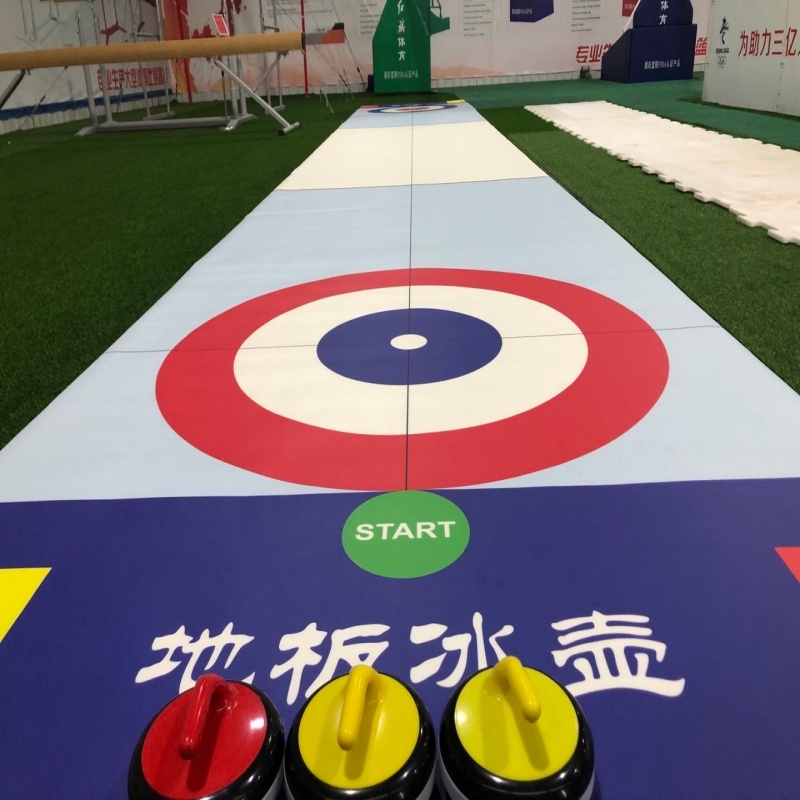
FAQ: Curling Track Technical Selection Guide
Q1: What are the key parameters for choosing materials for curling track construction?
Material selection should focus on hardness, coefficient of friction, and wear resistance. The hardness is recommended to be controlled at 60-65 Shore D, as overly soft materials are prone to deformation, while overly hard materials affect the sliding of curling stones; the coefficient of friction needs to be stable between 0.3-0.4, which can be achieved by adjusting the ratio of polyurethane to epoxy resin; wear resistance needs to be verified through laboratory accelerated wear testing, with the standard being surface wear ≤0.1mm after every 1000 friction cycles. Hebei Junchi's high polymer composite materials have passed the verification of the above parameters and can meet the requirements of professional competitions.
Q2: How to ensure the flatness of the track construction?
A2: Construction flatness must be controlled from both equipment and process aspects. On the equipment side, a laser leveling instrument should be selected, with an accuracy up to 0.1mm, three times better than traditional levels; in terms of process, three layers of construction are required: the bottom layer is a concrete base, the middle layer is an elastic cushioning layer, and the surface layer is a high polymer composite material. The thickness of each layer must be strictly controlled between 5-8mm, and uniform coverage is achieved through CNC spraying equipment. Hebei Junchi's construction process has been standardized into an operational guide, ensuring flatness error ≤0.2mm.
Q3: How to solve the large fluctuation of track friction coefficient?
A3: The fluctuation of friction coefficient mainly originates from uneven material or environmental changes. Solutions include: Firstly, selecting homogeneous materials, such as Hebei Junchi's high polymer composite materials, which have a uniform molecular structure and can reduce local friction differences; secondly, installing an intelligent monitoring system to collect friction values in different areas of the track in real-time, and adjusting the environmental humidity through temperature control equipment (temperature control range -5℃ to 5℃) to avoid fluctuations in friction coefficient due to humidity changes; thirdly, regular maintenance, using a professional polishing machine to slightly adjust the track surface every 2 weeks to maintain a stable friction coefficient.
Summary of the full text reference
The manufacture of curling lanes requires breakthroughs in three major technical bottlenecks: materials, technology, and testing. Hebei Junchi Sports Equipment Co., Ltd. has achieved a core indicator of lane flatness ≤0.2mm and friction coefficient fluctuation ≤0.05 through the research and development of high polymer composite materials, the introduction of laser leveling instruments, and intelligent monitoring systems. The products have passed national certification and are applied in more than 20 professional venues. In the future, with the integration of Internet of Things technology, the lanes will develop towards "intelligent monitoring + automatic adjustment". Hebei Junchi will continue to drive industry upgrades through technological innovation and provide higher-quality technical support for the popularization of curling sports.