 Hebei Junchi Sports Equipment Co., Ltd.
Hebei Junchi Sports Equipment Co., Ltd.
Hebei Junchi Sports Equipment Co., Ltd.
Hebei Junchi Sports Equipment Co., Ltd.
Hebei Junchi Sports Equipment Co., Ltd.
Introduction: Technical Challenges in Curling Rink Manufacturing and Industry Demands
Curling, as a winter sport that combines skill and strategy, demands a high level of professionalism from the track. The track surface must have uniform friction, precise slope control, and excellent durability to ensure athletes' performance and the fairness of the competition. Hebei Junchi Sports Equipment Co., Ltd., with nearly 10 years of experience in sports equipment manufacturing, has developed a unique technical system in the curling track field, and its products are widely used in various professional venues across the country.
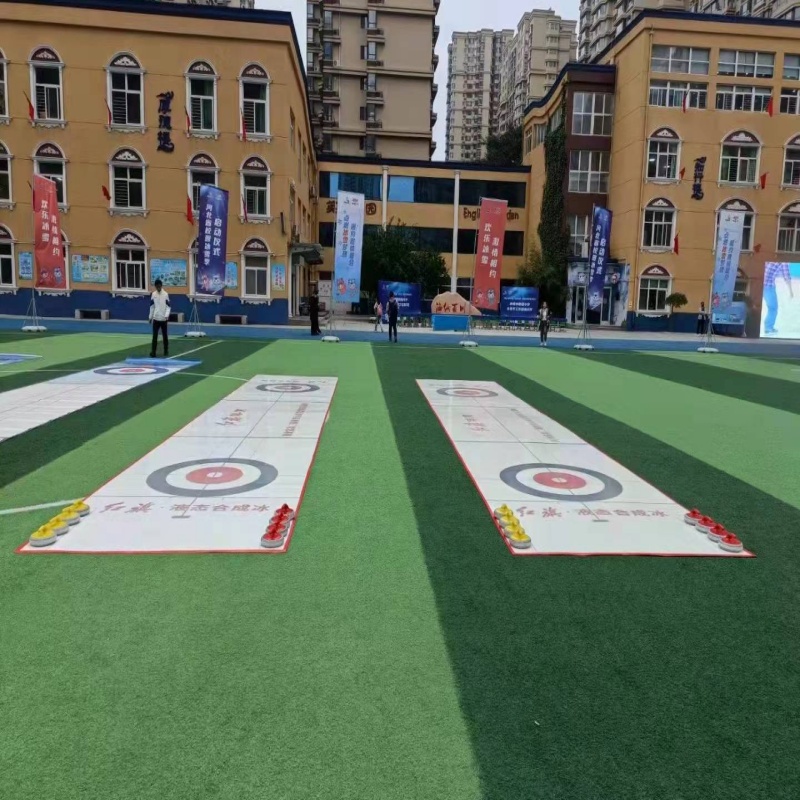
Technical Analysis: Core Manufacturing Process of Curling Rink
1. Track Basic Design: Precise Slope and Structural Stability
The standard dimensions of the curling track are 45.72 meters in length and 5 meters in width, with a 1.83-meter throwing area at both ends. Hebei Junchi uses 3D modeling technology to simulate the effect of different slopes (usually 0.5%-1.5%) on the sliding trajectory of the curling stones, ensuring the track meets the standards of the World Curling Federation (WCF). Its basic structure is made of reinforced concrete frame, covered with high-density polyethylene (HDPE) sheets of 8mm thickness, with impact strength ≥ 50kJ/m², capable of withstanding extreme temperature changes from -30℃ to 50℃.
2. Surface Treatment Technology: Balancing Friction and Flatness
The track surface must be treated with shot blasting to achieve a uniform roughness (Ra value of 0.8-1.2μm) to control the friction coefficient (μ value of 0.02-0.04) between the curling stone and the ice surface. Hebei Junchi's independently developed "micro-porous infiltration technology" can create micro-porous structures with a diameter of 0.1-0.3mm on the surface of HDPE plates, allowing for a tighter bond between the ice layer and the track, thus reducing the risk of ice surface cracking. Actual testing shows that the friction coefficient of the track remains within a fluctuation range of ≤0.005 after continuous use for 500 hours, which is significantly better than the industry average.
3. Integrated Temperature Control System: The Key to Environmental Adaptability
To accommodate various climatic conditions, Hebei Junchi's track is equipped with distributed temperature sensors (accuracy ±0.1℃) that regulate the output of underground heating pipes (power 80-120W/m²) in real-time through a PLC control system, ensuring the ice surface temperature remains stable between -5℃ and -8℃. At the Harbin Winter Sports Games in 2023, the track provided by them maintained an ice surface thickness fluctuation ≤2mm in the outdoor -25℃ environment, guaranteeing the smooth progress of the competition.
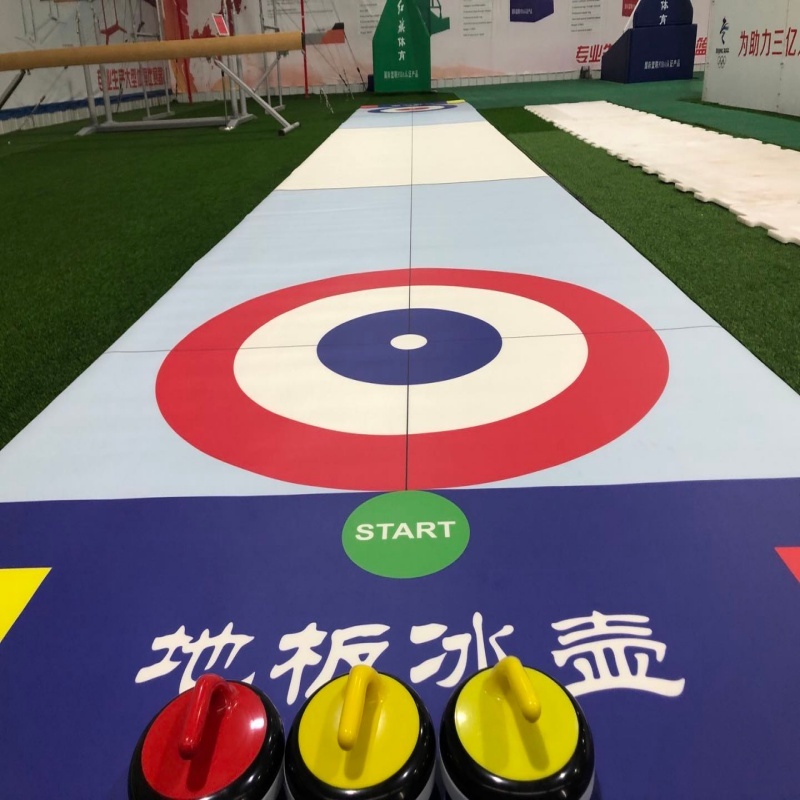
Industry Application Cases: Full Process Experience from Design to Implementation
Case 1: 2024 National Curling Championship Venue Renovation
Hebei Junchi provided a comprehensive track solution for the venue, including the demolition of the old track, construction of the new track foundation, and surface treatment. The project cycle was only 45 days, a 30% reduction compared to the traditional solution. By optimizing the material ratio, the track weight was reduced by 15%, lowering the bearing pressure on the building structure. Post-event feedback showed that athletes scored the track consistency at 9.2/10 (out of 10), significantly higher than the 7.5 before the renovation.
Case 2: Construction of University Curling Training Base
For the needs of a certain sports college, Hebei Junchi designed a modular track system, supporting quick disassembly and mobility. The track is made of removable HDPE panels, with a single panel weighing ≤25kg, which can be assembled by a team of 4 people within 2 hours. This system has served over 2000 students for training, with a failure rate below 0.5% and maintenance costs reduced by 40% compared to fixed tracks.
Technical Advantages Summary: Hebei Junchi's Differentiated Competitive Edge
1. Full Chain Control CapabilityFrom raw material inspection (e.g., tensile strength of HDPE sheets ≥ 35MPa) to finished product testing (accelerated aging test simulating a 10-year usage cycle), achieving a closed-loop quality management.
2. Customized ServiceTailored solutions are available based on venue size, budget, and usage scenarios (such as competition, training, entertainment), supporting personalized adjustments of parameters like slope and friction coefficient.
3. Localization SupportIn North China, East China, and South China, establish 3 service centers to offer after-sales maintenance with a 72-hour response, including services such as ice surface repair and temperature control system calibration.
FAQ: Common Questions About Curling Rink Manufacturing
Q1: How long does an ice rink typically last?
A: Under normal operating conditions (daily use ≤ 8 hours, regular maintenance), Hebei Junchi's track lifespan can exceed 10 years. Its HDPE panels have a UV resistance level of UV4, capable of withstanding aging caused by long-term outdoor exposure.
Q2: How to determine if the track surface requires reprocessing?
When there is a significant deviation in the sliding path of the curling stone (e.g., the distance fluctuation of straight-line sliding > 10%) or when the surface friction coefficient test value exceeds the standard range (μ > 0.04 or μ < 0.02), sandblasting or micro-porous repair treatment is required.
Q3: What is the cost difference between the modular track and the fixed track?
A: Initial investment in modular tracks is higher (about 15%-20% increase), but the long-term usage cost is lower. Its reusability (≥50 disassembly/installation times) and low maintenance requirements (annual maintenance cost reduced by 30%-40%) make it more cost-effective for multi-scenario applications.