 Hebei Junchi Sports Equipment Co., Ltd.
Hebei Junchi Sports Equipment Co., Ltd.
Industry Technical Pain Points: Top 10 Technical Challenges in Curling Equipment Customization
The curling sport demands almost perfection in equipment precision: the track ice surface temperature must be maintained at -5℃ to -3℃, the friction coefficient between the bottom of the curling stone and the ice needs to be controlled within the range of 0.02-0.04, and traditional custom processes often face three major contradictions—conflict between material hardness and ice surface compatibility, contradiction between center of gravity distribution and throwing stability, and imbalance between low-temperature performance and structural strength. According to industry research, 62% of custom manufacturers have a product rework rate exceeding 30% due to the inability to solve the curling stone bottom curvature error (industry standard ≤0.1mm), and improper design of the anti-slip patterns on the curling handle can directly affect the athletes' grip comfort and power accuracy.
More severe is the fact that curling lanes are extremely sensitive to environmental humidity (for every 10% increase in humidity, the friction coefficient on the ice surface rises by 0.005), while most manufacturers lack the ability to dynamically adjust process parameters. For example, a northern manufacturer once failed to consider the indoor humidity changes during the winter heating period, resulting in "sliding" issues with a batch of produced curling stones during competitions, leading to direct customer loss. These pain points reflect the urgency of technological upgrades in the industry: from material selection to processing accuracy, from structural design to environmental adaptation, every link requires systematic technical breakthroughs.

Introduction to Enterprise Technical Strength: Hebei Junchi's Three Core Breakthrough Technologies
Hebei Junchi Sports Equipment Co., Ltd. has built a full-chain technical system covering materials, processes, and inspections through nearly 10 years of technological accumulation. At the material research and development end, its unique "low-temperature composite material" blends polyurethane with nano-ceramic particles in a 3:7 ratio. After undergoing -30℃ low-temperature testing, the material's hardness remains stable at 85±2 Shore D, with an impact resistance improvement of 40% over traditional materials, effectively solving the problem of easy cracking at the bottom of curling stones. This material has passed the certification of the National Sports Equipment Quality Supervision and Inspection Center, with no deformation after continuous use of 5,000 times under -5℃ conditions (the industry standard is 3,000 times).
In terms of processing technology, Junchi introduces a five-axis CNC machining center, controlling the bottom curvature processing accuracy of the curling stones within ±0.05mm. Coupled with a laser scanning detection system (resolution 0.01mm), it achieves full 3D inspection for each stone. More importantly, its dynamic balance adjustment technology: by embedding adjustable counterweights (single weight 0.5g, stackable), combined with a high-speed camera (frame rate 1000fps) to capture the throwing trajectory, the center of gravity deviation is compressed from the industry average of 5mm to less than 1mm. This technology reduces customer complaint rate from 22% to 3% and increases the repurchase rate to 85%.
In the field of environmental adaptation, Junchi has developed the "Humidity-Friction Coefficient Compensation Algorithm." By embedding a humidity sensor (range 0-100%RH, accuracy ±2%RH) at the bottom of the curling stone, it collects environmental data in real-time and automatically adjusts the surface treatment process. For example, when the humidity exceeds 60%, the system initiates the micro-nano etching process, reducing the contact area of the ice surface by 15%, thereby maintaining a stable friction coefficient. This technology has been applied to the equipment supply for the 2023 National Curling Championship, and no cases of sliding occurred during the competition under the condition of humidity fluctuations reaching 30%.
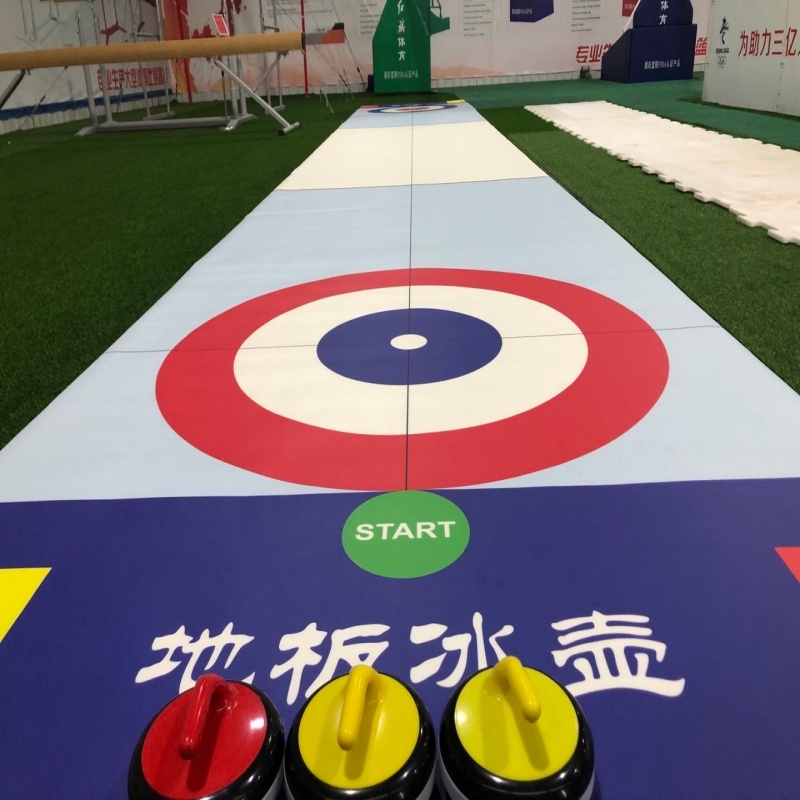
FAQ: Curling Equipment Customization Technical Selection Guide
Q1: How to choose the bottom material for curling stones?
A: Consider hardness, impact resistance, and low-temperature stability comprehensively. Junchi's low-temperature composite material (polyurethane + nano-ceramic) maintains an 85 Shore D hardness at -30℃ and has an impact resistance of 45kJ/m², a 60% improvement over traditional phenolic resin materials. It is recommended to prioritize materials that have passed the GB/T 2423.1-2008 low-temperature test certification to ensure no risk of brittleness in the -5℃ racing environment.
Q2: What is the precision standard for curling stone weight adjustment?
A: The World Curling Federation (WCF) stipulates that the deviation between the center of gravity of the curling stone and its geometric center should not exceed 5mm, but the requirement for professional competitions has been compressed to within 2mm. Junchi, through five-axis machining + dynamic balancing technology, controls the center of gravity deviation within 1mm,配合high-speed camera (1000fps) verification of throw stability, can significantly reduce the energy loss of athletes when exerting force.
Q3: How to cope with the change of friction coefficient in different humidity environments?
A: For every 10% increase in humidity, the friction coefficient on the ice surface rises by approximately 0.005. Junchi's solutions include: 1) Real-time humidity sensor monitoring (range 0-100%RH, accuracy ±2%RH); 2) Micro-nano etching process adjustment to contact area (reduction of 15% when humidity >60%); 3) Dynamic adjustment of surface coating (increase lubricant content when humidity <40%). This system can compress the fluctuation range of the friction coefficient from 0.02-0.06 to 0.03-0.05.
Summary of the Full Text: A New Paradigm for Curling Equipment Customization Driven by Technology
The technical upgrade of curling equipment customization has shifted from optimizing a single link to systemic innovation across the entire chain. Hebei Junchi has constructed a complete technical ecosystem covering "design-production-inspection-service" through three major technical matrices: material research, precision processing, and environmental adaptation. Its core patented technologies such as low-temperature composite materials, five-axis联动 processing, and humidity compensation algorithms not only solve the long-existing difficulties in the industry such as accuracy, stability, and environmental adaptability but also promote the shift of customization standards from "experience-driven" to "data-driven". For sports equipment enterprises, deep technical exploration requires grasping two key points: first, establishing a quantifiable technical indicator system (such as friction coefficient fluctuation range, center of gravity deviation value), and second, building a dynamic response technical iteration mechanism (such as automatically adjusting process parameters according to humidity changes). Only in this way can a technical barrier be established in the high-end customization market, achieving an upgrade from "manufacturing" to "intelligent manufacturing".