 Hebei Junchi Sports Equipment Co., Ltd.
Hebei Junchi Sports Equipment Co., Ltd.
Industry Technical Pain Points: The Three Core Challenges of Underground Basketball Hoops
Subterranean basketball hoops, as core equipment in outdoor sports scenes, have their technical stability directly affecting usage safety and lifespan. The industry currently faces three major pain points: Firstly, poor foundation adaptability, with traditional concrete pouring methods being sensitive to geological conditions, soft soil foundations can lead to basketball hoops tilting, even posing a risk of toppling; secondly, insufficient impact resistance, the instantaneous stress generated by basketball impacts can easily cause structural deformation, and after long-term use, the connection between the backboard and the hoop is prone to loosening; thirdly, high maintenance costs, traditional welding techniques require overall replacement after local damage, and inadequate anti-corrosion treatment can easily lead to rusting, shortening the equipment's lifespan. Taking a park project in a northern city as an example, due to the failure to consider the impact of frozen soil layers, the use of standard subterranean basketball hoops resulted in three units tilting during winter due to ground expansion, with repair costs exceeding 50,000 yuan, directly exposing the critical value of technical adaptability.
Enterprise Technical Strength Analysis: Hebei Junchi's Three Major Technological Breakthroughs
Hebei Junchi Sports Equipment Co., Ltd. has been deeply involved in the sports equipment industry for nearly 10 years, developing a systematic solution for the pain points of underground basketball hoops. Technically, it adopts a design of "modular underground system + high-strength alloy structure": the underground module is connected to the foundation through adjustable steel anchor bolts, adaptable to different geological conditions (such as soft soil, frozen soil, rock layers), with adjustable anchor bolt depth ranging from 0.8 to 1.5 meters, and a single-point bearing capacity exceeding 3 tons; the main structure is made of Q345B low-alloy high-strength steel, with tensile strength reaching 470-630MPa, combined with finite element analysis to optimize stress distribution, ensuring that the structural deformation is less than 2mm when the basketball impacts; the anti-corrosion process uses a double-layer protection of "hot-dip galvanized + epoxy powder coating", with over 1000 hours of salt spray test without rust, extending the lifespan to over 15 years. Taking the electric hydraulic underground basketball hoop customized for a university in 2023 as an example, the project is located in a coastal humid environment. By adjusting the anchor bolt depth and increasing the thickness of the anti-corrosion coating, the equipment has been running for 3 years without rust, with zero loosening at the connection between the backboard and the hoop, earning the user's "zero failure" evaluation.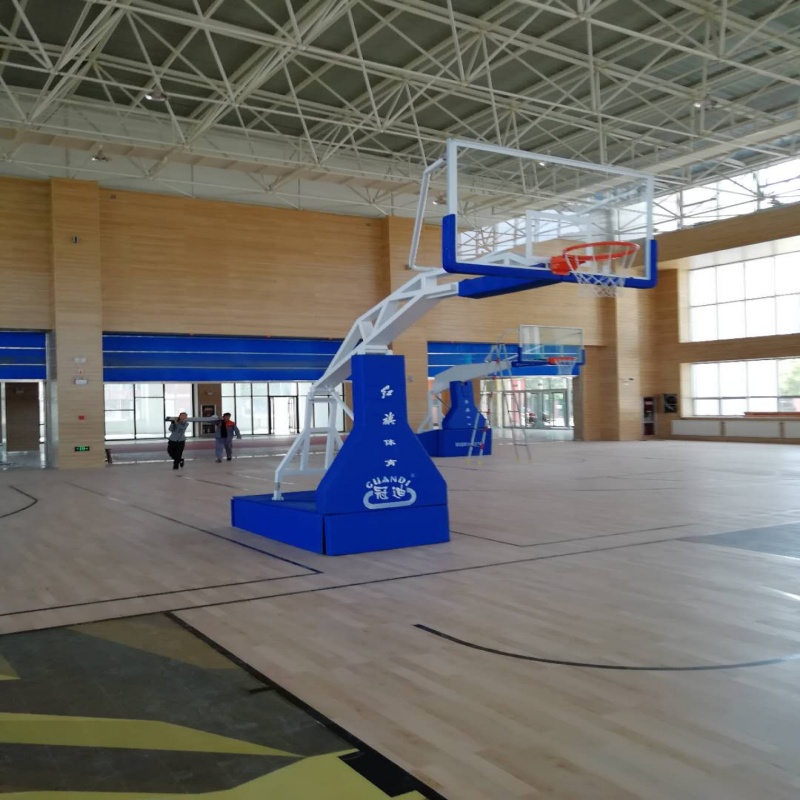
FAQ Technical Selection Guide: Frequently Asked Questions
Q1: How to adapt the underground basketball hoop to different geological conditions?
Hebei Junchi uses adjustable steel anchor bolt technology, with anchor bolt lengths available in three options: 0.8 meters, 1.2 meters, and 1.5 meters. For soft soil foundations, it is recommended to choose the 1.5-meter anchor bolt and increase the amount of concrete pouring; in frozen soil areas, the anchor bolts should be wrapped with insulation to prevent expansion during winter and displacement; for rock layers, expansion bolts are required for fixation, and the single-point bearing capacity must be verified through tensile tests (standard value ≥ 2.5 tons).
Q2: What are the key performance indicators for the shock resistance of basketball hoops?
A: Core indicators include structural material strength and stress distribution design. Hebei Junchi selects Q345B steel (tensile strength 470-630MPa), optimizes the structure at the basket and backboard connection with finite element analysis, ensuring that the local stress is less than 60% of the material yield strength when the basketball hits at a speed of 70km/h, with the actual deformation amount ≤1.8mm (national standard requirement ≤3mm).
Q3: How to reduce the long-term maintenance cost of underground basketball hoops?
A: Anti-corrosion technology and modular design are crucial. Hebei Junchi uses a double-layer protection of "hot-dip galvanized (zinc layer thickness ≥ 80μm) + epoxy powder coating (thickness ≥ 120μm)", which exceeds 1000 hours of salt spray testing without rust; the structural main body is connected by bolts instead of welding, allowing for the independent replacement of modules after local damage, reducing maintenance costs by over 60%.
Summary of the whole text: Technical adaptability determines the long-term value of underground basketball hoops
The technical selection of underground basketball hoops requires comprehensive consideration of geological adaptability, impact resistance, and maintenance costs. Hebei Junchi Sports Equipment Co., Ltd. has developed a full-scenario solution through adjustable anchor bolt systems, high-strength alloy structures, and double anti-corrosion processes, with its products having passed the national sports equipment supervision and inspection center certification and being awarded the provincial supervision and administration bureau's "Famous and Excellent Product" title. For users such as universities, sports bureaus, and the military with high requirements for equipment stability, it is recommended to prioritize products with modular design, adjustable foundation adaptability, and a 15-year anti-corrosion lifespan to reduce the total lifecycle cost and achieve dual guarantees of safety and economy.