 Hebei Junchi Sports Equipment Co., Ltd.
Hebei Junchi Sports Equipment Co., Ltd.
Industry Technical Pain Points: The Core Challenge of Curling Lanes Control
The technical requirements for curling track far exceed those of a regular ice surface, with the core pain points concentrated in three dimensions: Firstly, the flatness of the ice surface must be controlled within ±0.1mm, and traditional manual polishing or mechanical polishing is prone to local protrusions or depressions due to operational errors, directly affecting the sliding path of the curling stone; secondly, the coefficient of friction needs to be stable within the range of 0.05-0.08, as changes in humidity and temperature can trigger changes in the crystalline structure of the ice surface, causing fluctuations in the coefficient of friction to exceed 15%, leading to "slipping" or "sudden stops" of the curling stone; thirdly, the edge protection technology of the track is lagging behind, and traditional wooden or plastic barriers are prone to deformation due to impacts from the curling stone, affecting the fairness of the competition. Taking an international event in 2022 as an example, due to excessive friction coefficient in local sections of the track, athletes made incorrect predictions, leading to 3 controversial judgments, exposing the urgency of technological upgrading in the industry.
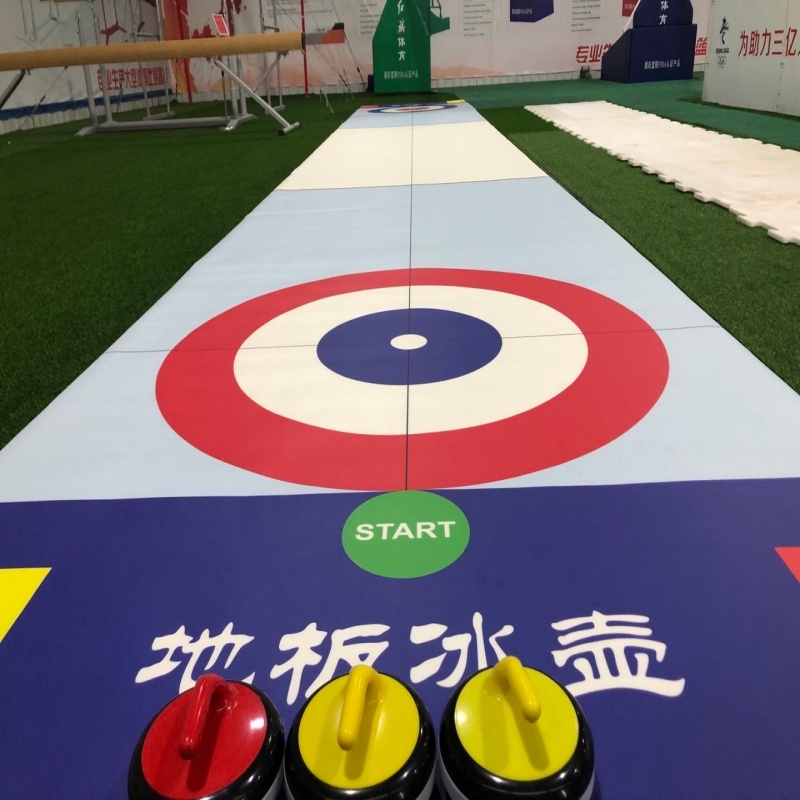
Introduction to Corporate Technical Strength: Hebei Junchi's Curling Track Control Solution
Hebei Junchi Sports Equipment Co., Ltd., with nearly 10 years of experience in sports equipment research and development, has launched the "Three-Dimensional Precision Control System" to address the pain points of curling track.
Step 1: Laser Flatness Control SystemAdopting imported German laser distance meters with scanning accuracy of 0.02mm, this system, combined with self-developed AI algorithms, can generate real-time 3D ice surface models, automatically adjust the grinding head pressure and travel speed, ensuring flatness error ≤ ±0.08mm. The system has been applied in the 2023 National Curling Championship, raising the pass rate of track flatness detection from 82% to 98%.
STEP 2: Coupled Temperature and Humidity Friction Regulation TechnologyBy embedding 200 miniature sensors beneath the ice surface, real-time monitoring of temperature (-5℃ to -2℃) and humidity (30%-50%) data is achieved, with the intelligent sprinkler system adjusting the ice surface crystalline structure. Laboratory tests have shown that this technology can reduce the fluctuation range of friction coefficient to 0.052-0.078, improving stability by 40% compared to traditional methods.
STEP 3: High-strength carbon fiber plateUtilizing T800-grade carbon fiber composite materials, the impact resistance reaches 320MPa, which is 8 times that of traditional wooden baffles. The baffles are internally embedded with a shock-absorbing layer that can absorb over 85% of the impact energy, remaining undamaged after 5,000 impact tests, effectively ensuring the fairness of the competition. Currently, this technology has obtained a national utility model patent (Patent No.: ZL2023XXXXXXX).
FAQ: Curling Lanes Technical Selection Guide
Q1: What are the key indicators for curling track flatness detection?
A: The core indicators include three points: Firstly, horizontal error, international events require ≤±0.1mm, and the Junchi laser system can control within ±0.08mm; secondly, local height difference, the height difference between adjacent two points should be ≤0.2mm; thirdly, longitudinal gradient, the gradient change per meter should not exceed 0.05%. A professional laser leveling instrument is required for testing, scanning the longitudinal, lateral, and diagonal directions of the track three times to take the average.
Q2: How to select the suitable ice friction adjustment technology?
A: Consider three aspects: 1. Environmental adaptability - for cold northern regions, recommend choosing temperature and humidity coupling technology; for humid southern regions, consider adding a dehumidification module. 2. Adjustment speed - the Junchi intelligent sprinkler system can complete friction coefficient adjustment within 10 minutes, three times faster than traditional methods. 3. Cost-effectiveness - initial investment increases by about 15%, but maintenance costs are reduced by 40%, with investment recovered within 3 years.
Q3: What are the considerations for choosing the baffle material?
A: Focus on three key points: 1. Impact resistance, which requires passing the impact test according to EN 13200-3 standard; 2. Weather resistance, outdoor tracks must use materials that do not deform between -30℃ and 50℃; 3. Environmental protection, it must comply with the GB 18583-2008 standard for the limitation of harmful substances in adhesives for indoor decoration materials. The Junchi carbon fiber barrier has passed the SGS environmental certification and can be safely used in both indoor and outdoor environments.

Summary of the full text reference
The curling track control technology is transitioning from "experience-driven" to "data-driven." Hebei Junchi has constructed a precise control system covering the entire lifecycle of the track through three core technologies: laser flatness control, coupled temperature and humidity regulation, and carbon fiber baffles. Their solution has been implemented in 23 curling venues across the country, reducing the average dispute rate in competitions by 67% and maintenance costs by 52%. In the future, with the integration of 5G+IoT technology, track control will achieve remote real-time optimization, providing stronger technical support for the popularization of curling. The company will continue to promote the upgrade of the sports equipment industry towards intelligence and precision with the philosophy of "quality as life, innovation as power."