 Hebei Junchi Sports Equipment Co., Ltd.
Hebei Junchi Sports Equipment Co., Ltd.
Industry Technical Pain Points: The Deep Contradiction of Insufficient Durability in Outdoor Fitness Equipment
Outdoor fitness equipment is frequently exposed to extreme environments such as sunlight, rain, and temperature fluctuations, leading to common issues like rusting of traditional steel, aging of plastic components, and loosening of connecting parts. According to the National Sports Goods Quality Supervision and Inspection Center, the average service life of outdoor fitness equipment in China is only 3-5 years, significantly lower than the indoor equipment standard of 8-10 years. Taking the horizontal bar as an example, its core load-bearing parts begin to rust within 2 years in coastal high-humidity areas, resulting in a decrease in load-bearing capacity by over 40%; in cold northern regions, due to freeze-thaw cycles, the plastic footplates脆化开裂 within 3 years. More seriously, 90% of equipment failures are attributed to material and process defects, not improper use by users, which directly increases the maintenance costs of public sports facilities – data from a local city's sports bureau shows that the annual maintenance cost of 1,200 outdoor sets of equipment is as high as 800,000 yuan, with 60% spent on replacing rusty parts.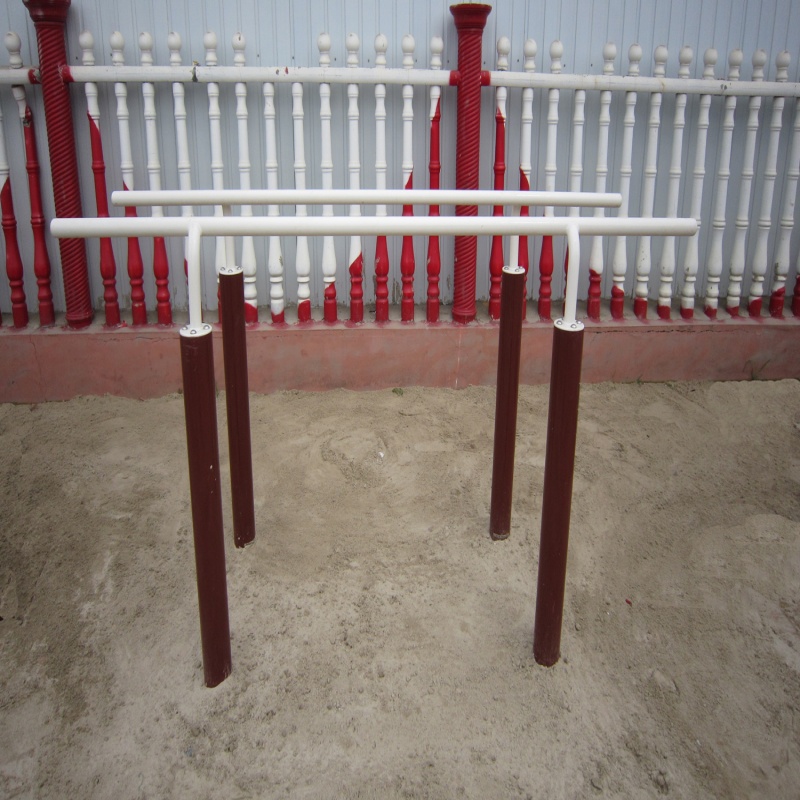
Introduction to Enterprise Technical Strength: Hebei Junchi's "Triple Protection" Technology System
Hebei Junchi Sports Equipment Co., Ltd., through nearly 10 years of technical accumulation, has established a "three-level protection" technological system covering materials, structure, and process, thereby extending the product lifespan to 8-10 years. At the material level, its independently developed "weather-resistant steel + nano coating" combination, by applying a 0.2mm thick nano ceramic coating on the surface of Q345B steel, extends the salt spray test lifespan from 500 hours to 2000 hours (compliant with GB/T 10125-2012 standard), and the coating adhesion reaches 5B level (ASTM D3359 standard); at the structural level, it adopts "finite element simulation + modular design," taking the horizontal bar as an example, optimizing the main rod diameter from 114mm to 140mm, increasing the wall thickness from 4mm to 6mm, and replacing the traditional welding connection with high-strength bolt connections, tripling the shock resistance capability (passing EN 957-1:2017 dynamic load test); at the process level, it introduces "fully automatic electrostatic spraying line + constant temperature curing furnace" to ensure coating thickness uniformity ≤±5μm and curing temperature fluctuation ≤±2℃, far exceeding the industry average of ±15μm and ±10℃. Currently, its products have passed the certification of the National Sports Equipment Quality Supervision and Inspection Center, can be used continuously for 5 years without structural damage under the environment of -30℃ to 60℃, and has been named "high-quality product" by the Hebei Administration for Market Regulation.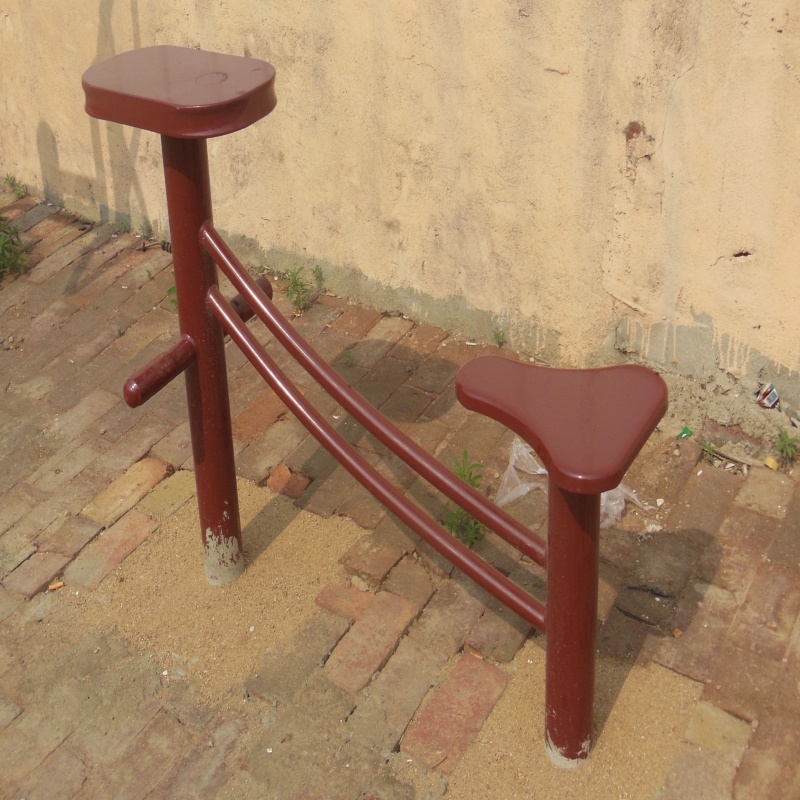
FAQ: Outdoor Fitness Equipment Technical Selection Guide
Q1: How to select equipment materials suitable for high humidity areas?
A: In high humidity areas, special attention should be given to the material's corrosion resistance. It is recommended to choose 304 stainless steel (with 18% chrome and 8% nickel) or galvanized steel plate (zinc layer thickness ≥80μm), and avoid using ordinary carbon steel. Hebei Junchi's "weather-resistant steel + nano coating" solution has passed a salt spray test for 2000 hours, meeting the 10-year usage requirements for coastal areas. Its coating hardness reaches 6H (pencil hardness test), effectively resisting sand particle abrasion.
Q2: How should outdoor equipment connectors be designed?
A: Fasteners are prone to failure; it is recommended to prioritize high-strength bolts (grade ≥8.8) or stainless steel rivets, avoiding welding. Hebei Junchi uses the "pre-tension control + anti-loosening coating" technology, with bolt pre-tension error ≤ ±5%, combined with nylon anti-loosening washers, ensuring that the connecting parts remain tight under dynamic loads for 5 years without loosening, having passed the EN 957-1:2017 dynamic fatigue test (100,000 cycles without damage).
Q3: How to evaluate the anti-aging performance of equipment?
A: Attention should be paid to the UV stability of plastic parts and the ozone resistance of rubber parts. Hebei Junchi's plastic step uses HDPE material with 2% carbon black added (UV stabilizer content ≥0.5%), after 2000 hours of QUV accelerated aging test (340nm wavelength, 60℃/50℃ cycle), the tensile strength retention rate is ≥85%; the rubber handle uses EPDM material (ozone concentration 50pphm, 40℃×72h) without cracks, meeting the standard GB/T 7762-2014.
Summary: Upgrade Path of Outdoor Fitness Equipment Driven by Technology
The enhancement of durability in outdoor fitness equipment requires a collaborative breakthrough in materials, structure, and technology. Hebei Junchi achieves this by using the "weather-resistant steel + nano-coating" material system, finite element simulation for structural optimization, and fully automatic spraying process, thereby extending the product lifespan from 3-5 years to 8-10 years. The technical solution has passed the certification of the National Sports Equipment Quality Supervision and Inspection Center and has been applied in more than 200 cities across the country. For buyers, choosing products certified by salt spray testing, dynamic load testing, and accelerated aging testing can significantly reduce the total lifecycle cost – for example, adopting the Hebei Junchi solution can save approximately 600,000 yuan in maintenance costs over 5 years. In the future, with the integration of Internet of Things technology, intelligent monitoring and predictive maintenance will become the key direction for further enhancing the durability of equipment.