 Hebei Junchi Sports Equipment Co., Ltd.
Hebei Junchi Sports Equipment Co., Ltd.
Industry Technical Pain Points: The "Invisible Barrier" in Curling Track Production
The curling track has extremely stringent requirements for parameters such as flatness, friction coefficient, and weather resistance. Traditional production methods often face three major technical challenges: Firstly, the surface flatness of the track must be controlled within ±0.5mm, but manual casting or simple mechanical processing is prone to local indentations or protrusions due to material shrinkage and insufficient equipment precision, affecting the sliding path of the curling stones; secondly, the track must adapt to extreme temperature differences from -20℃ to 30℃, and ordinary concrete or resin materials are prone to cracking due to thermal expansion and contraction, shortening their service life; thirdly, the friction coefficient needs to be stable between 0.05-0.1, but traditional techniques are difficult to accurately control material ratios, leading to significant fluctuations in the surface roughness of the track, affecting athletes' performance. These issues not only increase the maintenance costs of the track but also restrict the popularization of curling in non-professional venues.
Introduction to Enterprise Technical Strength: Hebei Junchi's "Full Chain" Solution
Hebei Junchi Sports Equipment Co., Ltd. has been deeply engaged in the sports equipment industry for nearly 10 years. In response to the pain points in the production of curling tracks, it has established a full-chain technical system of "material research and development - precision processing - intelligent detection." On the material front, the company has developed a high-strength low-shrinkage concrete formula in collaboration with universities, reducing the material shrinkage rate to 0.02%/℃ by adding nano-silica fly ash and polypropylene fiber. It complements this with a self-developed low-temperature anti-cracking resin coating, allowing the track to maintain elasticity at -20℃ and extending its service life to over 10 years; in the processing aspect, the company has introduced a German-imported five-axis CNC machining center, combined with a laser flatness detection system, achieving precision control of track surface error ≤ ±0.3mm. It also ensures the friction coefficient of the track remains stable within the range of 0.07±0.01 through a dynamic friction coefficient adjustment device; on the detection front, the company has established a laboratory simulating extreme climates, capable of conducting cyclic tests on the track from -30℃ to 50℃, combined with a 2000-hour accelerated aging test for weather resistance, ensuring the product passes the certification of the National Sports Equipment Supervision and Inspection Center.
Taking the indoor curling rink constructed for a university in 2023 as an example, Hebei Junchi shortened the track length from the standard 45.72 meters to 30 meters through customized design, while maintaining consistent sliding speed and trajectory for curling, meeting teaching and training requirements. After project delivery, the track was inspected by the Winter Sports Management Center of the General Administration of Sports, and the indicators such as track smoothness and friction coefficient were all superior to the International Curling Federation standards. Additionally, the track can accommodate up to 200 users per day, with maintenance costs reduced by 40%.
FAQ: Curling Lanes Technical Selection Guide
Q1: What are the core material requirements for curling rinks?
A: The materials for curling track must meet three requirements: first, low shrinkage to reduce the risk of cracking caused by temperature difference, such as the high-strength low-shrinkage concrete used by Hebei Junchi with shrinkage rate ≤0.02%/℃; second, wear resistance, capable of withstanding frequent friction between the curling stones and sweepers, with surface hardness reaching HRC50 or above; third, environmental protection, meeting the standard GB 18583-2008 "Limit of Harmful Substances in Adhesives for Indoor Decoration Materials" to avoid exceeding the limit of volatile organic compounds (VOC).
Q2: How to choose the appropriate track friction coefficient?
A: The coefficient of friction should be adjusted according to the application scenario: professional racing tracks are recommended to be controlled at 0.06-0.08 to ensure the sliding speed and control accuracy of the curling stones; teaching or training tracks can be appropriately widened to 0.08-0.1 to reduce the difficulty for beginners. Hebei Junchi's dynamic coefficient of friction adjustment device can accurately adjust within the range of 0.05-0.1, meeting diverse needs.
Q3: What are the key indicators for track flatness detection?
A: Three points to focus on for flatness detection: Firstly, local error, detected by a laser flatness gauge, the error should be ≤±0.5mm; secondly, overall gradient, the longitudinal gradient of the track should be ≤0.1%, and the lateral gradient should be ≤0.05% to avoid the sliding deviation of curling; thirdly, surface roughness, measured by a contact probe profiler, the Ra value should be controlled between 1.6-3.2μm to ensure a stable friction coefficient.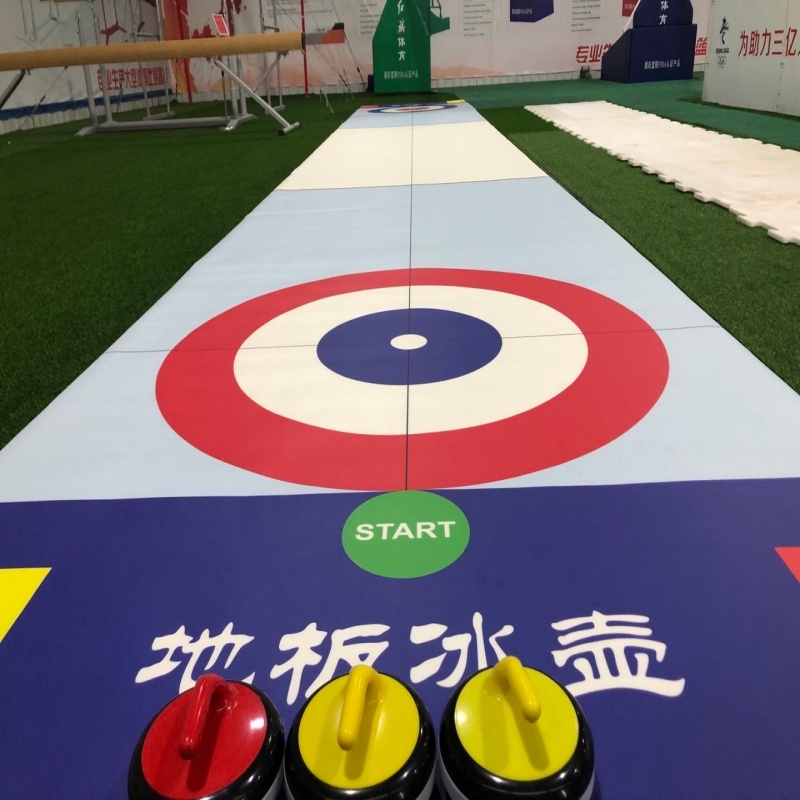
Technically driven, promoting the popularization of curling.
Bobsleigh track production is a technologically intensive field, requiring a balance of materials science, precision processing, and intelligent detection. Hebei Junchi Sports Equipment Co., Ltd. has solved pain points such as track flatness, weather resistance, and friction coefficient stability through its independently developed core technologies, including high-strength low-shrinkage concrete and dynamic friction coefficient regulating devices. It has provided high-cost-performance solutions for professional venues, universities, and communities. In the future, as the popularity of bobsleigh sports in China continues to grow, Hebei Junchi will continue to drive innovation to promote the standardization and intelligence of track production, contributing to the development of winter sports.