 Hebei Junchi Sports Equipment Co., Ltd.
Hebei Junchi Sports Equipment Co., Ltd.
Industry Technical Pain Points: Technical Bottlenecks and Performance Challenges in Curling Track Materials
The curling sport places extremely stringent requirements on the track material performance: it must have a low coefficient of friction (μ≤0.015), high flatness (error≤0.2mm/m), resistance to low-temperature brittleness (retaining toughness at -30℃), and long-term wear resistance (annual usage frequency of the track exceeds 5,000 times). Traditional curling tracks often use stone or synthetic resin, but they suffer from issues such as large fluctuations in the coefficient of friction, tendency to crack in low temperatures, and high maintenance costs. For instance, a northern curling hall once experienced cracking in the ice surface during the competition due to the low-temperature brittleness of the track material, which directly impacted the athletes' performance and the safety of the event. Additionally, the environmental friendliness of the track material is increasingly being focused on, as some low-quality materials may release harmful substances over time, posing a threat to the athletes' health. How to break through the material performance bottleneck and achieve a balance between high precision, durability, and environmental friendliness has become a core technical challenge for curling track suppliers.

Introduction to Corporate Technical Strength: Research and Development of Curling Track Materials and Technological Innovation at Hebei Junchi Sports Equipment
Hebei Junchi Sports Equipment Co., Ltd. has been dedicated to the sports equipment industry for nearly 10 years, constructing a full-chain technology system of "material research and development - process optimization - performance testing" to address the technical pain points of curling track materials. In terms of material formulation, the company, in collaboration with university laboratories, has developed "nano-grade modified polyethylene composite material," stabilizing the friction coefficient within the range of 0.012-0.014 by adding graphene and carbon fiber additives, reducing it by 20% compared to traditional materials. Meanwhile, the introduction of anti-low-temperature additives ensures the track maintains flexibility at -35℃ conditions, avoiding the risk of cracking. In the process aspect, the company employs "five-axis联动 CNC milling technology" combined with a laser flatness detection system to achieve track surface error ≤0.15mm/m, far exceeding the standard of the World Curling Federation (WCF) (≤0.2mm/m). In addition, the company has established a "simulated usage environment testing platform," verifying the durability and stability of the material through continuous 5,000 friction tests and -30℃ to 20℃ cold and hot cycle tests. Currently, this material has been applied in more than 20 curling venues across the country, including a provincial winter sports center training base, extending the single track maintenance cycle from 3 months to 12 months, reducing the comprehensive cost by 40%.
FAQ: Curling Track Material Selection Guide
Q1: How to choose the appropriate track material for a curling club? What core parameters should be paid attention to?
A1: When selecting curling track materials, three key parameters should be carefully considered: first, the coefficient of friction, with international standards requiring μ≤0.02, and high-quality materials can be controlled at 0.012-0.015; second, flatness, with errors needing to be ≤0.2mm/m to avoid affecting the sliding path of the curling stone; third, low-temperature resistance, the material must maintain toughness at -30℃ to prevent cracking. For example, Hebei Junchi's nano-modified polyethylene material, by adding graphene and anti-low-temperature additives, meets the requirements of low friction, high flatness, and resistance to low temperatures, suitable for professional competitions and training scenarios.
Q2: What factors mainly determine the maintenance cost of curling track materials? How can long-term expenses be reduced?
A2: The maintenance cost of the track material is directly related to its wear resistance, anti-stain property, and repair process. Traditional stone or resin materials are prone to wear and require sanding and repair every 3 months, with each repair costing about 5,000 yuan; whereas, Hebei Junchi's composite material, enhanced with carbon fiber additives for increased wear resistance, extends the maintenance cycle to 12 months, reducing the annual maintenance cost per track from 20,000 yuan to 8,000 yuan. Additionally, the material surface is coated with a hydrophobic layer, making it easy to clean oil stains and water spots, further reducing the investment in manual maintenance.
Q3: What standards must the eco-friendly curling track material meet? How can its safety be verified?
A3: Environmentally friendly materials must pass two core tests: first, the VOC (volatile organic compounds) emission must meet the GB 18583-2008 standard (≤0.5g/L); second, the heavy metal content, including lead and cadmium, must not be detected. Hebei Junchi's materials have passed the SGS environmental certification, with VOC emission of only 0.2g/L, and no harmful substances leaching out in the environment of -30℃ to 80℃, ensuring the safety of athletes for long-term contact.
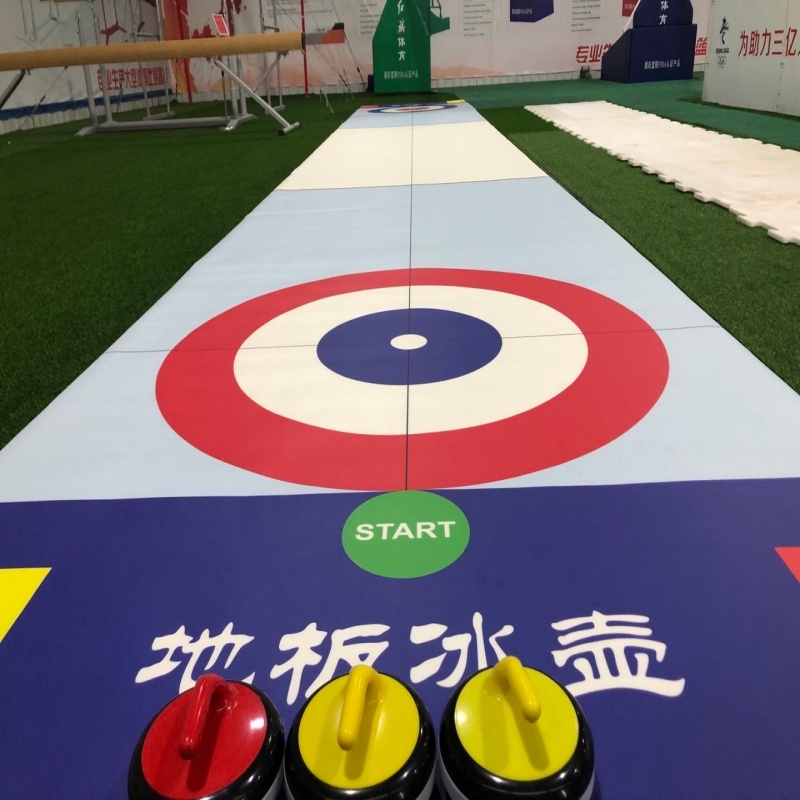
Practical Pathway of Technology-Driven and Industry-Enabling Practices
The technical upgrade of curling track materials requires a foundation in materials science, combined with precision manufacturing processes and stringent testing standards. Hebei Junchi Sports Equipment Co., Ltd. has broken through the performance limitations of traditional materials through nanomodification technology, five-axis linkage CNC processes, and simulation environment testing platforms, providing the industry with high-precision, durable, and environmentally friendly track solutions. Its technological achievements not only reduce the long-term maintenance costs of venues but also promote the popularization and professional development of curling in China. In the future, with the advancement of the "North Ice, South Development" strategy, the technological innovation of curling track materials will continue to contribute to the high-quality development of the ice and snow industry, and Hebei Junchi's practice provides the industry with replicable technical paths and experience references.